
Biomanufacturing Growth: Capacity Trends & CDMO Insights & Outlook

What is the outlook for biomanufacturing (drug substance)? How is industry capacity trending, and what is the outlook for outsourcing? A recent study by BioPlan Associates reveals key insights.
By Patricia Van Arnum, Editorial Director, DCAT, [email protected]
Capacity trends
The continued ascent of biologics in the industry’s pipeline and in commercial products bodes well for CDMOs of biologics, but how is the industry trending overall in terms of biomanufacturing capacity and in in-house versus outsourced production?
Current worldwide biomanufacturing (bioprocessing) capacity is estimated at approximately 15.2 million liters, with mammalian cell culture dominating, accounting for more than 71% of total global capacity, or approximately 10.9 million liters, and microbial fermentation accounting for about 24% or 3.74 million liters, according to a recent analysis, The 23rd Report and Survey of Biopharmaceutical Manufacturing Capacity and Production, by BioPlan Associates, a Rockville, Maryland-based business intelligence firm. The 2026 study included the input of 300 respondents (both biopharmaceutical companies and CDMOs)
Mammalian systems remain the workhorse of biologics manufacturing, particularly for monoclonal antibodies and newer recombinant protein therapies. The platform is seeing some capacity growth, but the pace is moderate, according to the BioPlan analysis. Microbial platforms are highly mature, well-optimized, and typically used for smaller, less complex biologics or enzyme production. Most facilities already have the capacity they need, and the platform’s role in the industry’s future pipeline is relatively limited compared to mammalian or cell and gene therapy systems. Cell or gene therapy platforms saw a rapid surge in facility buildouts and investment over earlier years and again in 2026. The current interest in capacity represents a strategic step towards optimization of existing processes and equipment, according to the BioPlan study.
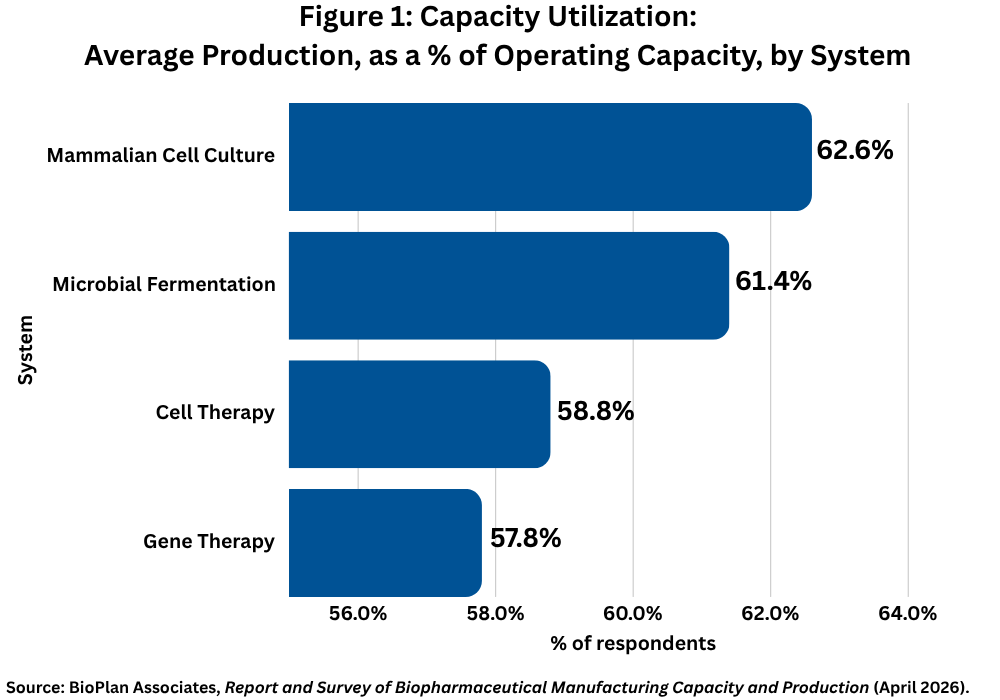
In terms of capacity utilization on an industry basis, overall mammalian capacity utilization is at approximately 62.6% based on the BioPlan study, followed by microbial fermentation at 61.4% and cell and gene therapies at approximately 58% (see Figure 1).

“What we wanted to do was measure specifically what capacity utilization was so that we could determine whether or not the demand expectation was real,” says Eric Langer, Managing Partner and President, BioPlan Associates, who noted that capacity utilization and related trends is a topic the firm has analyzed since the early 2000’s with the inception of its annual biomanufacturing analysis. “And this year (2026), we find on average that about 62.6% of mammalian cell culture capacity is currently being actively used. That is versus 57% last year and about 59% in 2023. Although that sounds like low utilization, it is actually fairly healthy. In biologics manufacturing, if you peak in the upper 70%’s in terms of capacity utilization, you are putting your facility at risk for not being able to do appropriate maintenance, cleaning, and so forth…In the mid-60%’s, is where you start to see actual capacity crunches occurring.” Langer shared his insights on biomanufacturing capacity trends, insourced versus outsourced activity, and technology trends in the latest episode of the DCAT Value Chain Insights podcast, Production to Prescription.
Other reasons for the fairly stable capacity utilization rates are optimized production processes for mainstream platforms, such as mammalian cell culture biomanufacturing, which reduces the need for outright capacity additions that are achieved through those productivity gains. In the case of mammalian systems, facilities are increasingly investing in high-capacity single-use systems, intensified perfusion processes, and continuous operations, which speaks to a “deepening, not just widening, of capacity,” notes the BioPlan study.
“Using existing capacity more efficiently takes pressure off and makes it less necessary to expand capacity,” explains BioPlan’s Langer. “Moreover, the aftermath of the COVID-19 pandemic led to a period of conservative decision-making in biomanufacturing, where companies are adjusting/waiting to see the new normal. In addition, companies are strategically managing their production schedules and capacities to maintain a steady utilization rate,” he says.
The incorporation of productivity-related metrics, with capacity utilization, is an approach further raised in the BioPlan study. “Capacity utilization alone no longer reflects industry productivity,” commented Renaud Jacquemart, Partner, BioPlan Associates in the study. “Capacity utilization remains an important industry metric, but it is becoming increasingly difficult to interpret in isolation. Improvements in cell line productivity, process intensification, perfusion manufacturing, automation, and downstream processing mean that a facility can generate significantly greater output without corresponding increases in reported utilization. Future assessments of industry capacity may benefit from incorporating productivity-adjusted measures in addition to traditional utilization metrics.”
Scale of mammalian capacity additions
When capacity is being added for mammalian systems, it is in the large and mid-scale range. The highest percentage for production capacity in 2026 was in mid-scale production (1,000 to 9,999 L) noted by 36.4% of the respondents in the BioPlan study. Capacity increases for large-scale production (10,000 to 74,999 L) was reported by 33.9% of the respondents in the BioPlan study. “As single-use systems are increasingly adopted for mammalian commercial-scale manufacturing, their wider adoption is expected to lead to even higher increases in the mid-scale ranges of commercial-scale manufacturing systems,” notes the BioPlan study. Small to moderate-scale production (<100 to 999 L) was indicated by 24.1% of respondents, and capacity increases with scale for greater than 75,000 L range had the lowest percentage with 5.6% of respondents citing capacity increases at this scale.
Matching capacity needs with available capacity
Despite the capacity gains, the BioPlan study showed that matching capacity needs by biopharmaceutical companies with available capacity has been a challenge, with approximately 49% of biopharmaceutical companies saying (by responding “strongly agree” or “agree” to the survey) that they were unable to find the right capacity for their production, compared to 41.3% in 2025 and 39.0% in 2024. “This is the pendulum swinging post-COVID,” says BioPlan’s Langer. “And what that means, I believe, is that essentially half of the industry is actively looking for that capacity for outsourcing, and they’re not able to find it—to find the right type of capacity, either the right competence, the right technical expertise, the right platforms, and so forth. And that is a little higher than the industry is typically accustomed to seeing. And that’s part, again, of this pendulum swing post-COVID.”
Geographic breakdown of capacity
On a geographic basis, Europe (28.3%), North America (27.7%) and China/Taiwan (19.2%) make up three-quarters of the active global biomanufacturing capacity overall (~15.2 million liters of capacity) according to the BioPlan Associates study. The next three regions include Japan and other Asian countries, India, and South/Central America.
In terms of geographic preference for outsourcing biomanufacturing, the US remains the most likely destination. The BioPlan study identified over 36 countries as potential outsourcing destinations, but the US remained the top choice for a substantial percentage of respondents. The percentage of biopharmaceutical companies that say that they would be “likely” or have a “strong likelihood” to outsource biomanufacturing to the US has grown from 30.1% in 2018 to 61.8% this year (slightly less than 64.7% of respondents in 2025 that cited a likely/strong likelihood to outsource to the US), according to the BioPlan Associates study. “The consistent rise in the likelihood of outsourcing to US facilities reflects a strategic preference for the country’s advanced capabilities and comprehensive services, positioning it as a key player in global bioprocessing expansion efforts,” according to the BioPlan study.
Outside the US, the top ten destinations for biomanufacturing outsourcing were in Europe, led by Germany and the UK, and the second region was Canada and Asia, with India and South Korea, representing significant outsourcing destinations. Outside the US, Germany ranked second as a likely destination for biomanufacturing outsourcing among respondents in the 2026 BioPlan study (46.1% of respondents) followed by the UK (42.1%), Canada (38.8%), and France (36.8%) among respondents in the BioPlan study. “While the US is the top destination of outsourcing, the combined opportunities across other regions represent a significant market for international outsourcing, highlighting that the nature of biomanufacturing expansion remains global,” notes the study.
One trend that continued in 2026 was the lower ranking of China as a source for biomanufacturing outsourcing, with China ranking eleventh as a potential outsourcing destination (32.2% of respondents citing it a likely designation for outsourcing). In comparison, China ranked fourth as an outsourcing destination in 2025 (30.1% of respondents). “The US has always been the number one likely destination for biomanufacturing outsourcing,” says BioPlan’s Langer, “but we found this year, partly because of the Biosecure Act and some of the political and geopolitical situations that we’re seeing” is the lower ranking of China in 2026 compared to previous years, including in 2025.
Level of biomanufacturing outsourcing
With respect to outsourcing biomanufacturing overall, Langer points out that the 2026 BioPlan study shows the continuing trend of biopharmaceutical companies outsourcing biomanufacturing to some level, a trend that is expected to continue over the next five years (2031). To illustrate that trend, Langer points to the level of biomanufacturing reported by biopharmaceutical companies done exclusively in-house.
“What we are seeing that that the decrease in in-house exclusive biomanufacturing over time was very consistent, at around 6% annually, to the point where now we’re looking at approximately only 18% of the industry saying that we manufacture 100% in-house,” says Langer. “That means four out of five manufacturers in this industry are essentially saying, ‘we are integrated with our outsourced manufacturing partners.’ What we have seen over the past two decades is the industry [i.e., biopharmaceutical companies] transform itself from essentially wanting to be manufacturers of biologics to wanting to be innovators of those biologics, and the manufacturing is simply done where it is most effectively done or where it is most cost-effectively done. So, to the extent that we are seeing a lot more integration of the manufacturing of biologics with the innovation of those biologics, you are creating a partnership that cannot necessarily easily be broken. And that is a major shift that we have seen over many decades now. And that is not going to go away.”
To break it down on a platform level, for mammalian cell culture systems, 17.5% of respondents in 2026 reported no outsourcing in their facilities (i.e., all production is done in-house), compared to 22.5% in 2025, 26.9% in 2024, 29.7% in 2023, and 31.0% in 2021, according to the BioPlan study. Overall, this is the lowest level since 2006 when 57.8% of the industry reported no outsourcing. In 2031, the BioPlan study showed this level dropping further to where only 12.7% of respondents says that they plan to do mammalian biomanufacturing exclusively in-house (see Figure 2 below).
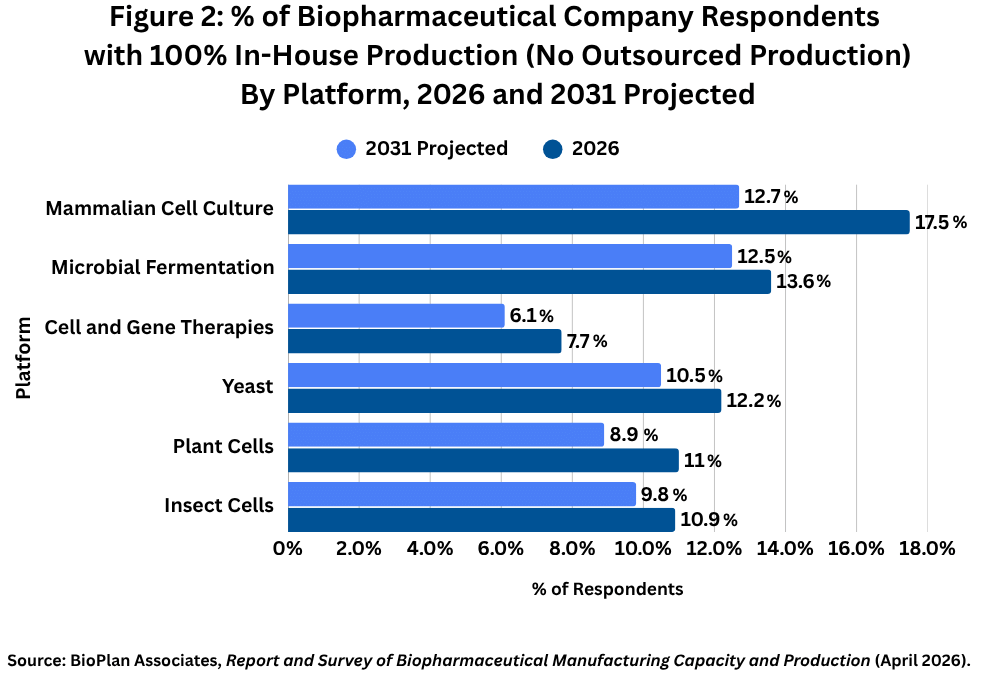
In 2026, only 13.6% of industry professionals cited that they conduct microbial fermentation exclusively in house, down from 22.0% in 2025, 30.2% in 2024, 34.3% in 2023, 40.0% in 2022, and compared to 58.1% reported in 2006. In 2031, this trend is expected to continue, with 12.3% of biopharmaceutical companies responding that they will exclusively do microbial fermentation in house, according to the BioPlan study.
For cell or gene therapies, only 7.7% of industry professionals reported no outsourcing (100% in-house) for 2026, down more than 50% from 17.4% in 2025. This 50% decrease of in-house production for cell or gene therapies was also recorded in 2025 where the percentage of no outsourcing was down to 17.4% from 30.4% in 2024. For 2031, only 6.1% of respondents’ project of exclusive production of cell or gene therapies in-house declined further to 6.1%
For other systems, in yeast system, 12.2% of facilities in 2026 reported exclusive in-house production, which was down from 15.2% in 2025 and 23.4% in 2024 compared to a high of 86.2% in 2006. In 2031, only 10.5% of respondents project exclusive in-house production for yeast systems.
For plant cells, 11.0% of respondents cited no outsourcing at their facilities, which was a higher percentage than 7.9% of facilities in 2025 but similar to 12.5% in 2024. Consistent with other platforms, the level of exclusive in-house production based on plant cells is projected to decrease, reaching 8.9% in 2031.
For insect cells systems, a slightly higher percentage of participants conducted production exclusively in-house in 2026, 10.9% of facilities compared to 9.5% in 2025. In 2031, the level of in-house production is projected to decline to 9.8%, according to the BioPlan study.