

How Can Today’s Supply-Chain Challenges Be Fixed?

A DCAT Week program brings together leading Bio/Pharma executives to offer their perspectives on how Bio/Pharma companies and their suppliers are adjusting supply practices now and in the near term.
Supply-chain challenges and solutions
Longer lead times. Inflationary pressures. Transportation bottlenecks. A changing geopolitical landscape. These are just some of the supply-chain challenges that Bio/Pharma companies and CDMOs/CMOs/suppliers are facing today. But the question is what can be done to address those issues?
The DCAT Week 2022 program, Executive Insights: Navigating the New Supply Chain Paradigm, on Tuesday, March 22, from 9:00 to 10:00 AM, will feature of panel of leading executives to share their perspectives on how the industry is and may further adjust its supply practices today and in the near term.
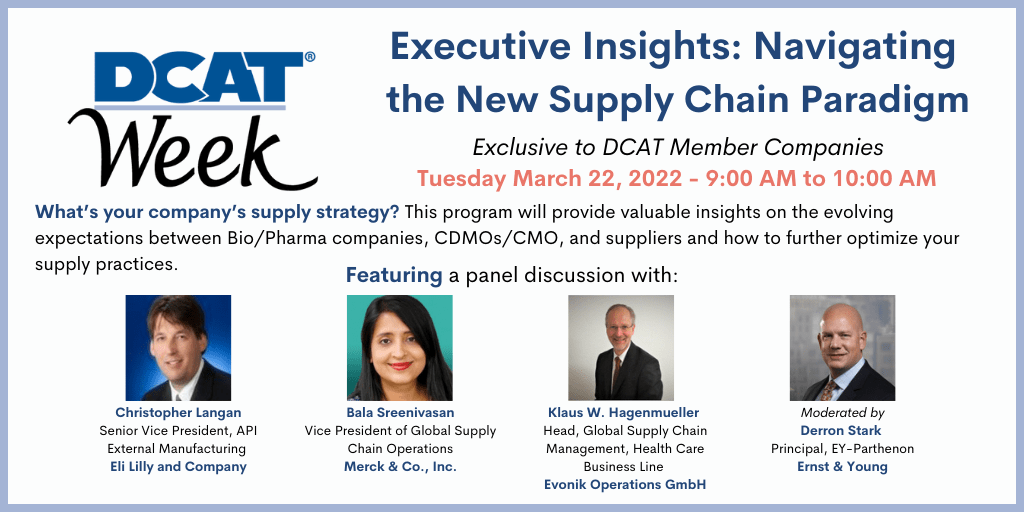
Participating in the panel to provide perspective on overall supply practices as well as specialized considerations for small-molecule drugs, biologics, and raw materials sourcing are: Christopher Langan, Senior Vice President, API External Manufacturing, Eli Lilly and Company; Bala Sreenivasan, Vice President of Global Supply Chain Operations, Merck & Co., Inc.; and Klaus W. Hagenmueller, Head, Global Supply Chain Management, Health Care Business Line, Evonik Operations GmbH. Derron Stark, Principal, EY-Parthenon, Ernst & Young, will moderate the panel discussion.
The executives will provide practical insights on some of the solutions to address the supply-chain challenges of today and how supply practices between Bio/Pharma companies and CMDOs/CMOs/suppliers have changed and how they will further evolve. They will provide perspectives on further measures for risk mitigation and supply-chain security, additional considerations in contracts, the pros and cons of increasing back integration, and raw materials sourcing strategies, including a discussion on the risk–reward of qualifying second sources and regional alternatives. Additionally, they will discuss how increased digitalization, including the use of artificial intelligence, can be applied to improve resource allocation and outcomes in sourcing and supply-chain functions.
Further information, including how to register for the DCAT Week program, Executive Insights: Navigating the New Supply Chain Paradigm, may be found here.