


Flexible Fill–Finish for an Unpredictable Market
If the last five years have taught us anything, it is that fill–finish capacity can disappear faster than anyone expects.
The industry moved from pandemic-driven demand to another surge almost immediately. That whiplash exposed something important. Long-range capacity assumptions do not hold for long anymore.
At the same time, pipelines are fragmenting. Alongside high-volume products, there is steady growth in specialized biologics and therapies targeting smaller patient populations. Many of these programs move quickly. Forecasts change late. Presentation decisions evolve as clinical data matures.
For CMC and technical operations teams, the question is no longer just whether capacity exists. The real question is whether a partner can adapt as your product changes.
Because it will.
Manufacturing Is Now a Strategic Inflection Point
Expedited regulatory pathways have shortened development timelines. Expectations around contamination control have increased. Annex 1 has raised the bar for facility design and environmental control. Global interpretations are not always aligned.
Meanwhile, sponsors are often committing to manufacturing strategies before long-term commercial demand is fully defined.
That combination puts sterile fill–finish squarely on the critical path.
Clinical supply must connect cleanly to commercial scale. Presentation changes cannot trigger major redevelopment. Regulatory standards must anticipate where the product is going, not just where it is today.
In this environment, fill–finish is not a transactional service. It is part of a company’s risk strategy.

What Flexibility Actually Means in Practice
Flexibility is frequently discussed, but less often defined.
In practical terms, it comes down to three things.
First, scalability. Programs may ramp faster than expected, or they may level off. They may require multiple concurrent batches to support global submissions. A partner must have operational headroom and disciplined scheduling to accommodate that movement without disruption.
Second, presentation readiness. A therapy may begin in a vial during clinical development and later transition to a prefilled syringe or cartridge. That shift requires planning, validated container closure strategies, supplier alignment, and regulatory foresight, so the transition does not create avoidable delays.
Third, regulatory durability. What is acceptable in early development may not withstand commercial inspection standards. Facilities and processes should be designed with that trajectory in mind from the start.
Flexibility is intentional design built around how products evolve.
Regulatory Expectations Are Not Static
The updated Annex 1 guidance has changed conversations across the industry. Sponsors are asking deeper questions about contamination-control strategies, isolator technology, and environmental monitoring.
But expectations do not stop at facility design. They extend into process validation, documentation, and long-term inspection readiness.
For CMC teams, this means evaluating not only whether a CDMO is compliant today, but whether its infrastructure is built to support products through commercialization and beyond.
Forward planning reduces rework, protects timelines, and preserves credibility with regulators.
Afton Scientific’s Approach
Afton Scientific has focused exclusively on sterile fill–finish for more than 20 years. That focus informs how we invest, how we structure our teams, and how we engage with clients.
In a market often dominated by large multi-site organizations, Afton offers a distinct approach. Clients engage directly with senior leadership and experienced technical teams. We make sure that communication is direct and challenges are addressed quickly and transparently.
Today, we support sterile filling into vials across a range of batch sizes and formulation types, including temperature-sensitive and high-viscosity products, as well as controlled substances.
Our in-house analytical and microbiology laboratories, recently expanded, allow us to develop and validate methods internally. Maintaining analytical capabilities under the same roof as manufacturing reduces handoffs and strengthens control over development timelines.
Equally important is how we structure partnerships. Clients work directly with senior leadership and experienced technical teams. Decisions are made quickly. Communication is direct. Operational realities are not filtered through layers of hierarchy.
When timelines tighten or strategies shift, that access matters.
Expanding with a Clear Purpose
Market demand is evolving, and so are we.
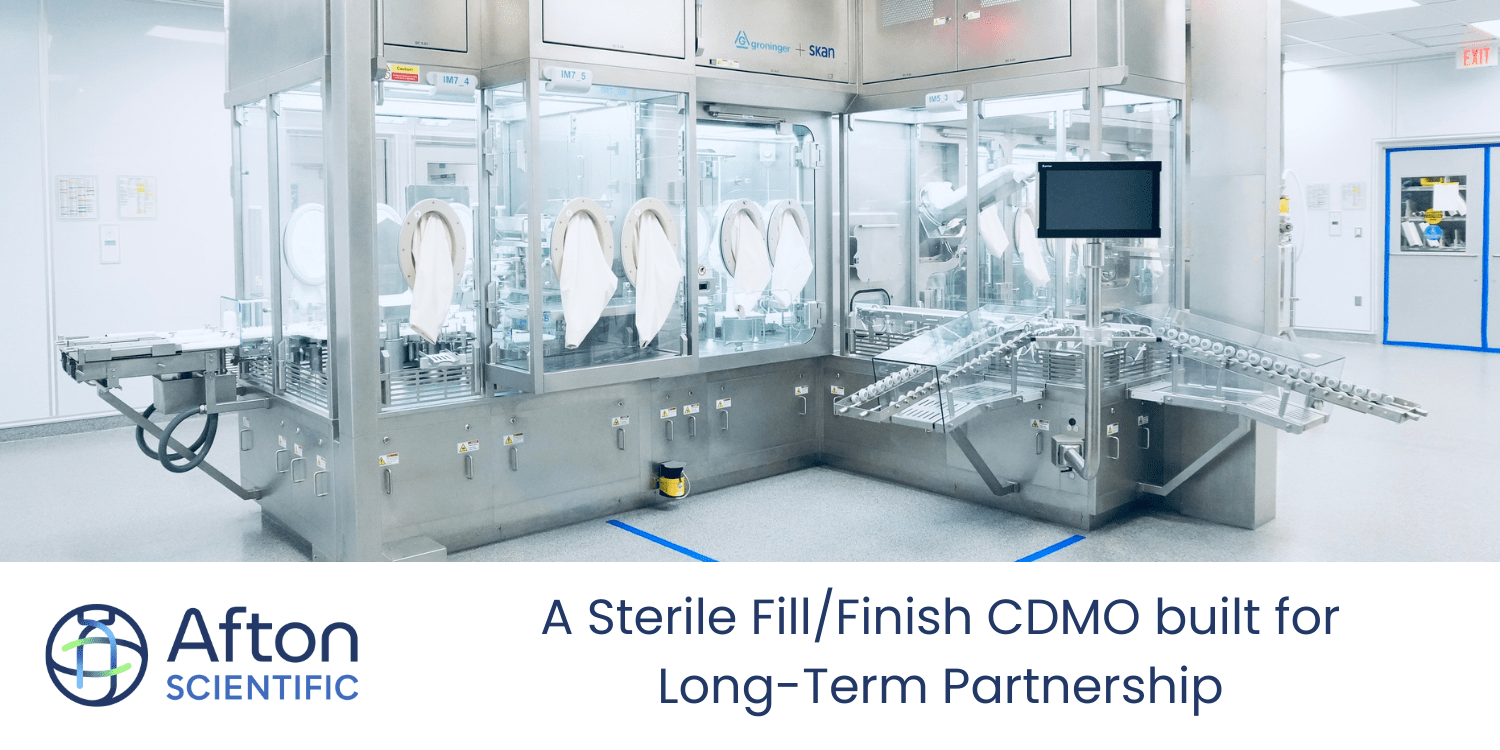
In the second half of 2026, Afton will bring online a new isolator based, Annex 1-compliant Flexfill filling line. This addition will introduce sterile filling into prefilled syringes and cartridges alongside vials. For sponsors, that means greater flexibility as products move from clinical development toward commercialization without the need to change partners.
The Flexfill line will also support ready-to-use components, simplifying preparation steps, and accelerating onboarding for new programs.
Looking further ahead, we broke ground last September on a new facility targeted for completion in 2028. The design incorporates modular cleanroom infrastructure and staged expansion capability. Additional filling lines can be installed as demand grows, rather than forcing disruptive transfers or rushed retrofits.
Standardized equipment strategies across facilities will streamline tech transfer and training, preserving consistency as operations expand.
Growth, for us, is intentional. Expansion decisions are tied to real demand and ongoing dialogue with clients, not speculative forecasts.
Scaling Without Sacrificing Access
Growth often introduces distance between sponsors and decision makers. Afton’s structure is intentionally designed to prevent that. Clients maintain direct engagement with senior executives and experienced technical leaders. Long-tenured staff and a collaborative culture support continuity and accountability across projects.
As portfolio complexity increases across the industry, credibility matters as much as speed. Afton emphasizes realistic commitments, transparent scheduling, and proactive risk identification.
Flexibility only has value if it is paired with reliability.
The Road Ahead
The science driving today’s pipelines is only becoming more diverse. Personalized medicines, advanced biologics, and specialized delivery formats will continue to shape demand patterns. Regulatory expectations will continue to rise and supply-chain strategies will continue to evolve.
Sterile fill–finish cannot simply be an outsourced function. It must be a partnership built around adaptability, technical depth, and accountability.
At Afton Scientific, we are investing in infrastructure that anticipates change while preserving the direct collaboration that has defined our work for more than two decades.
If you are evaluating sterile fill–finish strategy for an upcoming clinical or commercial program, we welcome the conversation.
Learn more at aftonscientific.com.
