


Start-up Allos AI Announces Seed Funding for AI-Enabled Pharma R&D, Formulation Development
CEO
Allos AI
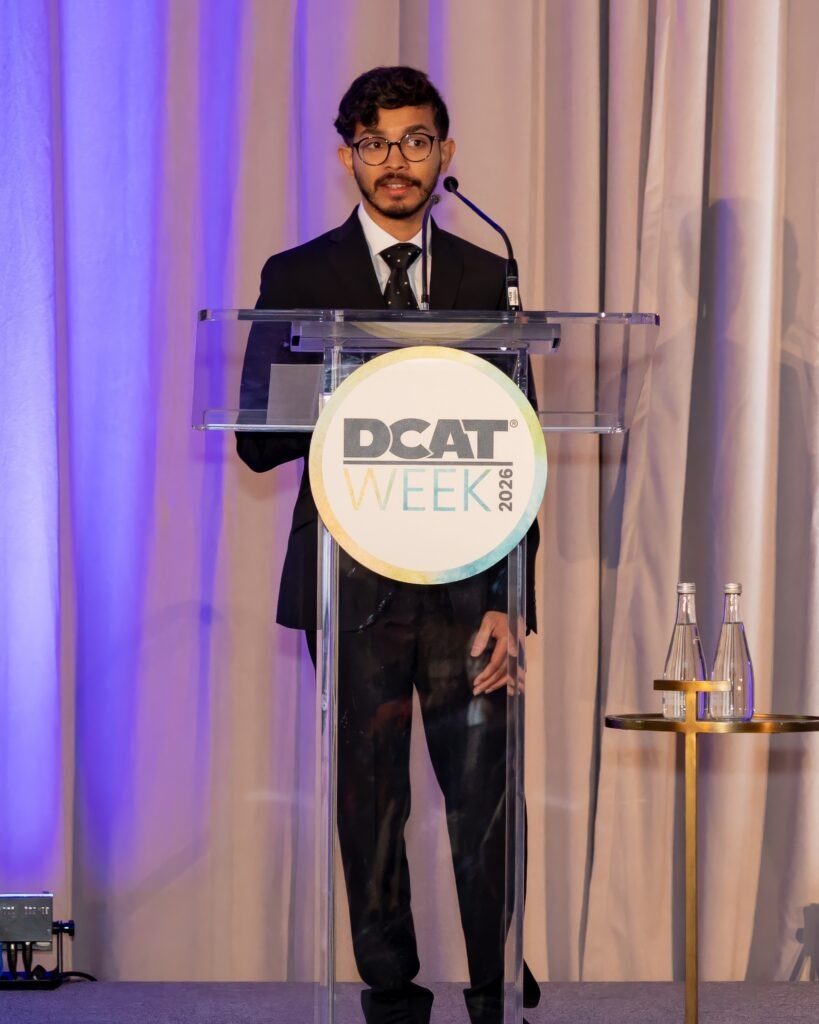
Aditya Iyer, PhD, CEO and co-founder of Allos AI, a start-up company applying causal artificial intelligence (AI) to pharmaceutical research and development, including formulation development, outlined the company’s strategy and use of its AI platform at the DCAT Member Company Announcement Forum, held March 23, 2026, at DCAT Week.
Allos AI, an Oxford University spinout incorporated in 2024, recently closed a seed funding round (raising $5 million) and outlined its vision to verticalize AI across the pharmaceutical R&D cycle, from formulation development through clinical studies. The company is building AI-native pharma R&D that applies causal AI to reduce uncertainty in drug development with the goal of accelerating the path from discovery to clinical success.
Iyer said that the company’s approach contrasts with traditional machine-learning methods commonly applied in pharmaceutical research. While conventional models rely on large datasets and pattern recognition, Allos’ causal AI framework focuses on identifying cause-and-effect relationships between formulation variables, pharmacokinetics, biomarkers, and clinical outcomes. This so-called “glass-box” approach enables explainable models that can work with realistic datasets and guide experimental design rather than simply analyzing results after the fact, according to the company.
One key application of the technology is the optimization of formulation design of experiments. Using causal inference and Bayesian optimization, Allos generates targeted experimental runs that identify the excipient combinations and process conditions most likely to achieve desired performance characteristics, such as improved solubility, stability, and manufacturability. By narrowing the experimental search space, the company aims to reduce development cycles and lower the number of wet-lab experiments required to reach viable formulations.
Beyond formulation development, the company is applying its causal AI platform to bioequivalence (BE) studies and clinical trial design. The technology models the relationships between active pharmaceutical ingredients, pharmacokinetic parameters, patient characteristics, and clinical outcomes to identify factors that drive variability in clinical performance. The company says this allows sponsors to design more robust BE studies and clinical trials, optimize patient stratification strategies, and improve endpoint selection, with the goal of increasing the probability of clinical success.
Allos says it has already demonstrated early validation of its platform in real-world data applications. In one example, the company used causal AI to analyze clinical datasets and improve treatment matching in inflammatory disease cohorts, reducing non-response rates to biologic therapies by approximately 30%. The company also developed a novel liquid oral dosage form of a BCS II drug for the 505(b)(2) regulatory approval that applied the capabilities of its platform in the generics space. BCS refers to the Biopharmaceutical Classification System (BCS), which is used to classify medicines based on dissolution, water solubility, and permeability. A BCS II drug refers to drugs with high permeability and low solubility. The 505(b)(2) new drug application pathway was created by the Hatch-Waxman Amendments of 1984, with 505(b)(2) referring to a section of the Federal Food, Drug, and Cosmetic Act. An 505(b)(2) NDA contains full safety and effectiveness reports but allows at least some of the information required for NDA approval, such as safety and efficacy information on the active ingredient, to come from studies not conducted by or for the NDA applicant. It can be used to obtain the approval of a new drug that contains similar active ingredients to a previously approved drug and is used for changes in dosage form, strength, route of administration, formulation, dosing regimen, or new indication.
The company says that its AI platform has processed more than 100,000 patient records across multiple studies and is currently supporting validation studies and real-world evidence programs focused on treatment matching, patient stratification, and regulatory compliance. These efforts are intended to help pharmaceutical partners generate actionable insights from observational healthcare data while meeting evolving regulatory expectations for evidence generation.
Looking ahead, Allos says it plans to continue expanding its capabilities across formulation design, clinical trial optimization, and real-world evidence generation. By integrating causal AI directly into the pharmaceutical development workflow, the company aims to help sponsors design better drugs and more predictable clinical programs in order to improve the efficiency of drug development and clinical outcomes.
