

Oral Obesity Drug Battle Is On with FDA OK for Lilly’s Orforglipron

Lilly is entering the oral obesity drug market by gaining FDA approval for Foundayo (orforglipron), a small-molecule (non-peptide) oral GLP-1 receptor agonist, setting up head-on competition with an oral version of Novo Nordisk’s obesity drug, Wegovy (semaglutide).
By Patricia Van Arnum, Editorial Director, DCAT, pvanarnum@dcat.org
Lilly and Novo Nordisk battle in oral obesity drug market
The battle in the obesity drug market is heating up as this week (April 1, 2026) Eli Lilly and Company reported that it had received approval from the US Food and Drug Administration (FDA) for its oral obesity drug, Foundayo (orforglipron). Foundayo is a once-daily small-molecule (non-peptide) oral glucagon-like peptide-1 (GLP-1) receptor agonist (RA) that can be taken any time of the day without restrictions on food and water intake. Analysts project blockbuster potential (defined as sales of $1 billion or more) for the drug with the oral administration being a key driver for revenue potential.
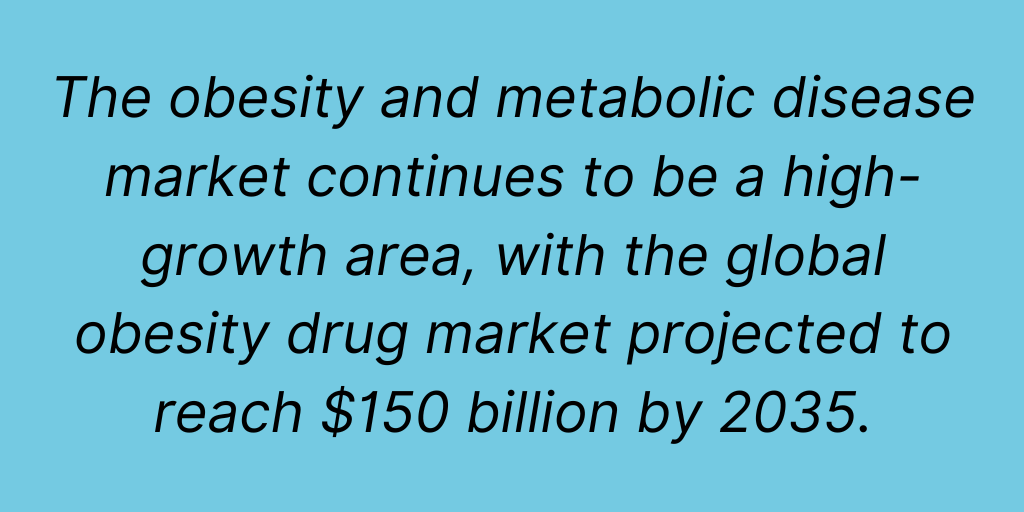
The obesity and metabolic disease market continues to be a high-growth area, with the global obesity drug market projected to reach $150 billion by 2035, according to a recent analysis by Clarivate, a business intelligence firm serving the bio/pharmaceutical industry. GLP-1 agonists, used to treat Type 2 diabetes and obesity, were the industry’s success stories with Novo Nordisk riding a blockbuster wave with Ozempic/Wegovy (semaglutide), respectively for treating Type 2 diabetes and obesity, and Eli Lilly and Company also riding the wave with Mounjaro/Zepbound (tirzepatide), a dual-activating GIP (glucose-dependent insulinotropic polypeptide) and GLP-1 medication, respectively for treating Type 2 diabetes and obesity.
Orforglipron is the first oral, non-peptide, small-molecule GLP-1 RA to be approved. It can be taken without food or water restrictions at any time of the day. As such, it represents a breakthrough in convenience and accessibility compared with injectable alternatives, according to the Clarivate analysis. Clarivate projects a blockbuster future for orforglipron with expected sales of $11.1 billion for obesity in G7 markets (Canada, France, Germany, Italy, Japan, the UK, and the US) in 2031, and $5.2 billion in expected sales for Type 2 diabetes in the G7 markets in 2031.
Orforglipron was approved for adults with obesity or overweight with weight-related medical problems. Foundayo will be available via LillyDirect with prescriptions accepted immediately (as reported on April 1, 2026) and shipping beginning April 6, followed shortly after by broad availability through US retail pharmacies and telehealth providers.
Lilly has submitted orforglipron for weight management and/or Type 2 diabetes in more than 40 countries and plans to launch in each country shortly after approval. Orforglipron was discovered by Chugai Pharmaceutical and licensed by Lilly in 2018. In addition to chronic weight management, orforglipron is being studied as a potential treatment for Type 2 diabetes, obstructive sleep apnea, osteoarthritis knee pain, hypertension, peripheral artery disease, and stress urinary incontinence.
In launching orforglipron, Lilly will be competing with Novo Nordisk and its oral obesity drug, oral semaglutide, the same active ingredient as in its injectable obesity drug, Wegovy, and injectable Type 2 diabetes drug, Ozempic. The GLP-1 drug received FDA approval in late December 2025 and was launched in the US in January (January 2026). Novo Nordisk already had an oral version of semaglutide, the active ingredient in Ozempic and Wegovy, on the market in Rybelsus, which was first approved in 2019, but that is indicated for treating Type 2 diabetes, not obesity.
Last year (2025), Novo Nordisk had sought to further position itself in the obesity drug market with a bid to acquire Metsera, a New York-based clinical-stage bio/pharmaceutical company focused on obesity and cardiometabolic diseases, eventually losing a bidding war with Pfizer, which acquired Metsera last November (November 2025) in a deal worth up to $11 billion. Metsera’s portfolio included both oral and injectable incretin, non-incretin, and combination therapy candidates, with four programs in clinical development and several programs with investigational new drug-enabling studies ongoing. These included MET-097i, a weekly and monthly injectable GLP-1 RA about to begin Phase III development; MET-233i, a monthly amylin analog candidate being evaluated as a monotherapy and in combination with MET-097i in Phase I development; an oral GLP-1 RA candidate in Phase I development; and additional preclinical nutrient-stimulated hormone therapeutics. Pfizer’s move to acquire Metsera followed recent setbacks in Pfizer’s in-house drug candidates for obesity. Pfizer discontinued development of two GLP-1 RAs: lotiglipron in 2023 and danuglipron in April of 2025.
Other contenders in the oral obesity drug market
Roche is advancing an oral GLP-1 receptor agonist for obesity, CT-996, which it gained through its 2024 acquisition of Carmot Therapeutics, a Berkeley, California-based bio/pharmaceutical company, in a deal worth up to $3.1 billion ($2.7 billion at closing plus $400 million in potential milestone payments). The acquisition provided Roche with three clinical-stage assets with potential in treating obesity and diabetes: as previously mentioned, CT-996, a once-daily oral small-molecule GLP-1 receptor agonist for treating obesity in patients with and without Type 2 diabetes, as well as two injectable clinical drug candidates: CT-388, a once-weekly subcutaneous injectable for treating obesity in patients with and without Type 2 diabetes, and CT-868, a once-daily subcutaneous injectable, for treating Type 1 diabetes patients with overweight or obesity.
AstraZeneca and Eccogene, a Shanghai, China-based bio/pharmaceutical company are partnered for Eccogene’s elecoglipron, an investigational oral, once-daily small-molecule GLP-1 RA, for obesity. AstraZeneca reported earlier this year (January 2026) that it plans to initiate Phase Ill trials for the drug. In November 2023, Eccogene entered into a global licensing agreement with AstraZeneca for elecoglipron while retaining co-development and co-commercialization rights in China.
Structure Therapeutics, a San Francisco-based clinical-stage global biopharmaceutical company developing oral small molecule therapeutics for metabolic diseases with a focus on obesity, is advancing alenigliprone, a GLP-1 RA for treating obesity and Type 2 diabetes. The drug recently completed Phase II development, and the company reported last month (March 2026) that it anticipates initiating a Phase III program in the second half of 2026.
Merck & Co. is partnered with China-based Hansoh Pharm for an oral small-molecule GLP-1 RA, now in early-stage development. In December 2024, the companies entered into an exclusive global license agreement for Hansoh Pharm’s HS-10535 (now MK-4082), which gave Merck an exclusive global license to develop, manufacture, and commercialize the drug in a $2.0-billion deal ($112 million upfront and milestone payments of up to $1.9 billion). Hansoh Pharma may co-promote or solely commercialize the drug in China, subject to certain conditions.