


Biotech IPOs: Who Is Topping the Class of 2026?

What companies are topping biotech IPOs in 2026? Parabilis Medicines with a focus on alpha-helical peptides and Kailera Therapeutics specializing in GLP-1s and related drugs for obesity are leading the way.
By Patricia Van Arnum, Editorial Director, DCAT, pvanarnum@dcat.org
Rising to the head of the biotech IPO class
Looking at biotech initial public offerings (IPOs) thus far in 2026, two companies, Parabilis Medicines and Kailera Therapeutics, top the list in financing raised. What is attracting interest?
In launching its IPO, Parabilis Medicines (Cambridge, Massachusetts) set the bar with the largest biotech IPO thus far in 2026. The company launched its IPO this week and reported this week (June 11, 2026) gross proceeds of $770.5 million, (including the full exercise of the underwriters’ option to purchase additional shares and before deducting underwriting discounts and offering expenses). In addition, Parabilis received gross proceeds of approximately $75 million from the sale of shares of common stock in a concurrent private placement with Regeneron Pharmaceuticals, a Tarrytown, New York-based bio/pharmaceutical company, as part of a collaboration formed by the companies last month (May 2026).
Parabilis is focused on developing a proprietary and specialized class of peptides, Helicons, which are stabilized, cell-penetrant alpha-helical peptides that are designed to engage intracellular protein targets, including flat surfaces not well suited to traditional small-molecule binding. With its technology, the company says it is seeking to resolve the problem of “undruggable” drug targets, whereby small molecules can enter cells but cannot bind to flat surfaces, and antibodies and other highly selective biologics that can selectively bind to flat protein surfaces but cannot enter cells to access these targets.
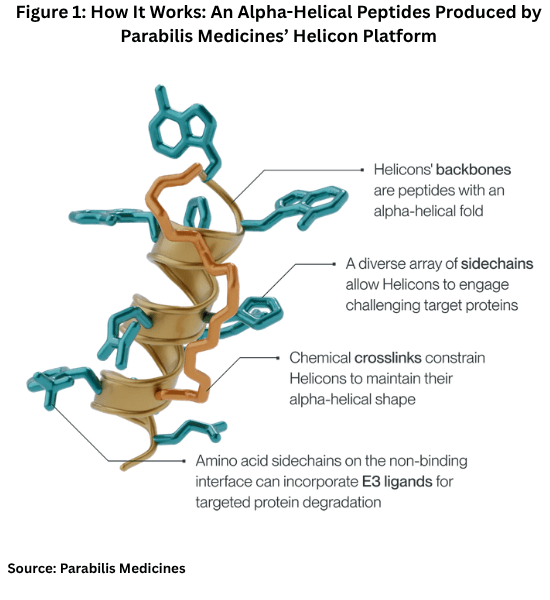
The company has developed a large set of non-canonical amino acids (i.e., non-natural amino acids) and has proprietary linkers for stabilizing peptides into an alpha-helical conformation (see Figure 1). With this dataset of non-canonical amino acids and their properties, the company applies AI and physics-based computational methods for Helicon design and optimization. The company’s initial programs are focused on disrupting protein–protein interactions and inducing targeted protein degradation, but the company says its Helicon platform can incorporate other advances in small-molecule drug design and extend them to targets that may be out of reach for other modalities.
Last month (May 2026), Parabilis inked a strategic research agreement with Regeneron Pharmaceuticals, a Tarrytown, New York-based bio/pharmaceutical company, to discover and develop multiple therapeutic candidates based on Parabilis’ proprietary Helicon peptide platform, in a deal worth up to $2.3 billion ($125 million upfront and $2.2 billion in milestone payments). The collaboration is designed to explore the use of Helicons both as standalone therapies and as part of what the company terms as Antibody Helicon Conjugates (AHCs) in which the alpha-helical peptide, the Helicon, is chemically linked to a targeted antibody to become part of an antibody–peptide conjugate. In addition to the potential of Helicons to address previously undruggable targets, the collaboration’s intent is to couple Helicons to Regeneron’s proprietary VelocImmune derived-antibodies, which are fully human monoclonal antibodies.
In its deal with Regeneron, Parabilis is to receive $125 million from Regeneron in the form of a $50-million upfront payment and $75 million as part of Parabilis’ equity financing. Parabilis is also eligible to receive milestone payments for development, regulatory, and commercial milestones, as well as tiered royalties up to the low double-digits on future net sales of any approved medicines resulting from the collaboration. With five initial targets, the agreement provides the potential for up to approximately $2.2 billion in total milestone payments to Parabilis. Additional targets may be pursued upon additional option payments from Regeneron.
Parabilis’ lead candidate is zolucatetide, in Phase I/II development, which is being evaluated across multiple solid tumor indications for treating solid tumors caused by alterations in the Wnt/b-catenin cell-signaling pathway, which regulates cell proliferation and differentiation and whose hyperactivation is a driver across many tumor types. Zolucatetide’s lead indication is for treating desmoid tumors, rare, locally invasive soft tissue tumors that form in the connective tissue. The drug has received Fast Track Designation and Orphan Drug Designation for the treatment of desmoid tumors from the US Food and Drug Administration
The company’s preclinical pipeline provides additional examples of the Helicon approach and includes programs targeting two key drivers of prostate cancer, the ETS-related gene and the androgen receptor in its active state. The company’s pipeline is focused on various cancers and tumor types; however, the company says it believes Helicons could also have broad applicability against targets in diseases outside of oncology.
Kailera Therapeutics: next wave of GLP-1s for obesity
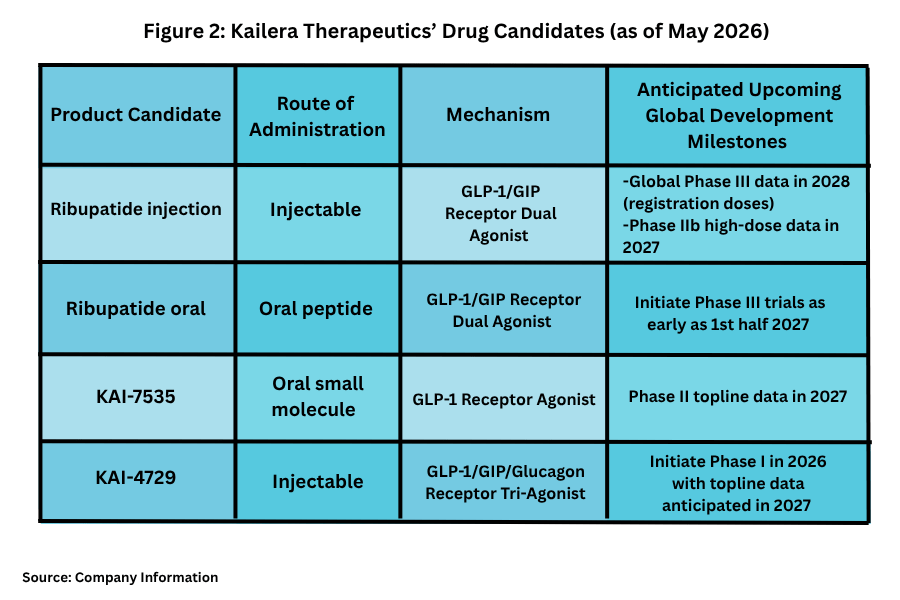
In the second hightest IPO of 2026, Kailera Therapeutics (Waltham, Massachusetts), a clinical-stage bio/pharmaceutical company developing drugs for treating obesity/overweight, raised gross proceeds of $718.8 million (including the full exercise of the underwriters’ option to purchase additional shares and before deducting underwriting discounts and offering expenses) through its IPO in April (April 2026). The company is applying multiple glucagon-like peptide-1 (GLP-1)-based mechanisms of action and routes of administration and has four clinical drug candidates (see Figure 2 below). The company’s lead product candidate is ribupatide, a GLP-1/GIP (glucose-dependent insulinotropic polypeptide) receptor dual agonist peptide being developed as a once-weekly subcutaneous injection and as a once-daily oral pill for the treatment of obesity and overweight.
Kailera is partnered with Hengrui Pharma (Shanghai, China) on ribupatide. In May 2024, Hengrui granted Kailera exclusive global rights outside Greater China to develop, manufacture, and commercialize Hengrui’s portfolio of innovative GLP-1 therapeutics, including ribupatide injection and oral ribupatide. Metabolic and cardiovascular diseases is one of therapeutic focuses of Hengrui, a China-based innovator drug company, which is also focused on oncology, immunological and respiratory diseases, and neuroscience. Last month (May 2026), Bristol-Myers Squibb and Hengrui Pharma entered into global strategic collaboration and license agreements to advance a portfolio of 13 early-stage programs in oncology, hematology, and immunology, in a deal worth up to $15.2 billion ($600 million upfront and $14.6 billion in milestone payments).
Kailera’s/Hengrui’s ribupatide injection is in global Phase III trials as a once-weekly injectable GLP-1/GIP receptor dual agonist. Kailera is also expanding the ribupatide franchise by developing a once-daily oral formulation and is advancing the development of two other drug candidates: KAI-7535, a once-daily oral small-molecule GLP-1 receptor agonist, and KAI-4729, a once-weekly injectable GLP-1/GIP/glucagon (see Figure 2 above).
Kailera Therapeutics is led by President and CEO, Ron Renaud, who prior to taking the helm at Kailera Therapeutics with its launch in October 2024, was a Partner at Bain Capital and held leadership roles with several biotech companies later acquired by pharmaceutical majors. These companies included: Cerevel Therapeutics (President and CEO), acquired by AbbVie in 2024 for $8.7 billion; Translate Bio (Chairman and CEO), acquired by Sanofi in 2021 for $3.2 billion; and Idenix Pharmaceuticals (President and CEO), acquired by Merck & Co., in 2014 for $3.85 billion.
The company’s leadership team also includes Jamie Coleman, Chief Commercial Officer, who prior to joining Kailera spent 17 years at Eli Lilly and Company, where she held key roles in brand strategy, consumer marketing, and global commercial leadership across therapeutic areas. Most recently, she served as Vice President, US Brand Leader for Zepbound (tirzepatide), Lilly’s blockbuster obesity drug, a dual-activating GIP and GLP-1 receptor agonist, and was previously US Brand Leader for Lilly’s Trulicity (dulaglutide), a GLP-1 receptor agonist for treating Type 2 diabetes.