
Generics/Biosimilars Outlook: Major Patent Cliff Looms Large
An estimated $500 billion in branded innovator drugs face generics/biosimilar exposure between 2026 and 2032. Which companies and products face the potential greatest impact?
By Patricia Van Arnum, Editorial Director, [email protected]
Navigating the patent cliff
For innovator companies, the loss of exclusivity always looms large as companies continually seek to replenish their pipelines organically or through partnering deals or acquisitions. For generics/biosimilars companies, medicines losing exclusivity translate into opportunities. In the the near and mid term, the bio/pharma industry is now facing a large patent cliff, with several of the large bio/pharmaceutical companies facing generics/biosimilars competition for top-selling products and key blockbusters (defined as products with sales of $1 billion or more). More than $500 billion in sales are potentially at risk from generics/biosimilar competition between 2026 and 2032, according to a recent analysis by Evaluate Pharma.
Figure 1 outlines a near-term window with key drugs facing generics/biosimilars competition currently and through 2030. Merck & Co.’s Keytruda (pembrolizumab), an immuno-oncology drug and the company’s top-selling product is perhaps the most noteworthy drug facing the patent cliff. Keytruda/Keytruda Qlex (pembrolizumab and berahyaluronidase alfa-pmph) posted 2025 sales of $31.68 billion, almost half (49%) of Merck’s total 2025 sales of $65.01 billion.

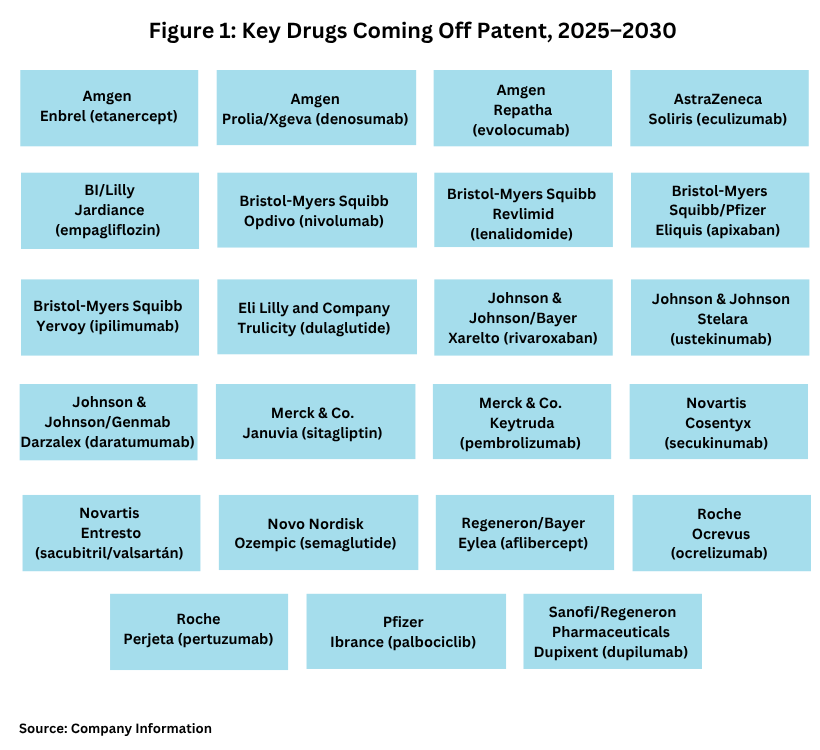
Johnson & Johnson (J&J) is already facing biosimilars competition for Stelara (ustekinumab), once its top-selling drug, for treating certain immune-mediated inflammatory conditions. Stelara continues to face headwinds from biosimilars competition, posting first-half sales of $1.40 billion, a 57.4% decline year over year. In the full-year 2025, Stelara had revenues of $6.08 billion and $10.36 billion in 2024.
J&J is banking on the continued success of Tremfya (guselkumab), an anti-inflammatory drug, as a successor to Stelara. Tremfya, a monoclonal antibody and interleukin-23 (IL-23) inhibitor, posted first-half 2026 sales of $3.56 billion, a 70.6% increase year over year and full-year 2025 sales of $5.15 billion. J&J will also be adding to its portfolio for next-generation drugs to Stelara with Icotyde (icotrokinra), an IL-23 receptor antagonist for treating plaque psoriasis and the first and only targeted oral peptide that blocks the IL-23 receptor, according to information from J&J. The drug was approved by the US Food and Drug Administration (FDA) in May (May 2026). Icotyde was jointly discovered and is being developed under a license and collaboration agreement between J&J and Protagonist Therapeutics, a Newark, California bio/pharma company. Icotyde is also being studied in active psoriatic arthritis, moderately-to-severely active ulcerative colitis and moderately-to-severely active Crohn’s disease. J&J also faces biosimilars competition for Darzalex (daratumumab), the company’s top-selling drug in 2025 with sales of $14.35 billion.
Bristol-Myers Squibb (BMS) faces generics/biosimilars competition for two products in its growth portfolio, both immuno-oncology drugs: Opdivo (nivolumab) with 2025 sales of $10.05 billion and Yervoy (ipilimumab) with 2025 sales of $2.9 billion. In the company’s legacy portfolio, the generics exposure is for BMS’ top-selling drug, Eliquis (apixaban), an anticoagulant with 2025 sales of $14.44 billion, and for Revlimid (lenalidomide) for treating multiple myeloma with 2025 sales of $2.95 billion.
Amgen has two of its top-selling drugs facing biosimilars competition: Prolia/Xgeva (denosumab) for treating osteoporosis and lowering fracture risk and Repatha (evolocumab), a drug indicated for treating certain forms of high cholesterol, including heterozygous familial hypercholesterolemia, an inherited genetic disorder that causes high cholesterol levels. Prolia/Xgeva is the company’s top-selling drug with 2025 sales of $4.41 billion, and Repatha is its second selling drug with 2025 sales of $3.02 billion. Also facing biosimilars competition is Enbrel (etanercept) for treating inflammatory autoimmune conditions such as rheumatoid arthritis, plaque psoriasis, and psoriatic arthritis and which posted 2025 sales of $2.23 billion.
Novo Nordisk Ozempic (semaglutide), its blockbuster Type 2 diabetes drug, for the most part will not face generics competition until the early 2030s, but its patent will expire in several countries starting in 2026, including in India and Canada.
Eli Lilly and Company is well-positioned in its Type 2 diabetes and obesity franchise with Mounjaro/Zepbound (tirzepatide) and recently approved Foundayo (orforglipron) but an earlier Type 2 diabetes drug, Trulicity (dulaglutide), which had 2025 sales of $4.28 billion, faces biosimilars incursion as does another blockbuster Type 2 diabetes drug, Jardiance (empagliflozin), which is co-developed and co-commercialized with Boehringer Ingelheim.
Johnson & Johnson (J&J) is already facing biosimilars incursion for Stelara (ustekinumab) for treating certain immune-mediated inflammatory conditions. Stelara continues to face headwinds from biosimilars competition, posting first-half sales of $1.40 billion, a 57.4% decline year over year. In the full-year 2025, Stelara had revenues of $6.08 billion and $10.36 billion in 2024.
J&J is banking on the continued success of Tremfya (guselkumab), an anti-inflammatory drug, as a successor to Stelara. Tremfya, a monoclonal antibody and interleukin-23 (IL-23) inhibitor, posted first-half 2026 sales of $3.56 billion, a 70.6% increase year over year and full-year 2025 sales of $5.15 billion. J&J is also adding a next-generation drug to Stelara with Icotyde (icotrokinra), an IL-23 receptor antagonist for treating plaque psoriasis and the first and only targeted oral peptide that blocks the IL-23 receptor, according to information from J&J. The drug was approved by the US Food and Drug Administration (FDA) in May (May 2026). Icotyde was jointly discovered and is being developed under a license and collaboration agreement between J&J and Protagonist Therapeutics, a Newark, California bio/pharma company. Icotyde is also being studied in active psoriatic arthritis, moderately-to-severely active ulcerative colitis, and moderately-to-severely active Crohn’s disease. Longer term, J&J faces biosimilars competition for Darzalex (daratumumab), the company’s top-selling drug in 2025 with sales of $14.35 billion.
Novartis already faces generic competition for Entresto (sacubitril/valsartán), a drug for treating chronic heart failure, and the company’s top-selling drug with 2025 sales of $7.75 billion. Longer term, the company faces biosimilars competition for it second-best seller, Cosentyx (secukinumab) for treating immune-mediated inflammatory conditions such as plaque psoriasis, psoriatic arthritis, and ankylosing spondylitis. Cosentyx had 2025 global sales of $6.67 billion.
Sanofi faces biosimilars competition in the mid-term with Dupixent (dupilumab), the company’s top-selling product and key revenue contributor, accounting for 42% of the company’s first-half 2026 sales with sales of EUR 9.32 billion ($10.73 billion). Dupixent will continue to be the key revenue contributor for the company with projected annual sales projected to reach around EUR 25 billion ($28.79 billion) in 2030. Dupixent, which was co-developed and commercialized with Regeneron Pharmaceuticals, a Tarrytown, New York-base bio/pharmaceutical company, generated net sales of EUR 15.71 billion ($18.10 billion) in 2025, representing 36.0% of Sanofi’s net sales for 2025. The primary US compound patent for Dupixent expires in March 2031. The company noted it has a “vigorous defense planned” with expectation to protect Dupixent innovations beyond the US compound patent expiration through a “robust” patent portfolio of issued patents and pending applications with expiration dates from 2031 to 2045. Shorter term, the company faces regulatory exclusivity in the US in 2029.
Also facing competition is AstraZeneca’s rare-disease drug, Soliris (eculizumab), which it gained through its $39-billlion acquisition of Alexion Pharmaceuticals in 2020, for treating paroxysmal nocturnal hemoglobinuria, a rare blood disease and other blood conditions. The company has already positioned the next-generation product for Soliris, Ultomiris (ravulizumab-cwvz), which posted 2025 sales of $4.72 billion.