
Innovation & Pharma: The Molecules & Companies

How truly innovative is the bio/pharma industry? What products, modalities, and companies are behind that innovation? Looking at “first-in-class” new drug approvals, defined as drugs with new mechanisms of action over existing drugs, reveals an interesting picture.
By Patricia Van Arnum, Editorial Director, DCAT, [email protected]
First-in-class new drug approvals: the trends
New product innovation is crucial for the bio/pharmaceutical industry, and one way to delve more deeply into new product innovation is to look at “first-in-class” new drug approvals. First-in-class, as defined by the US Food and Drug Administration (FDA), refers to a drug with a new mechanism of action different from existing therapies as of the time of approval by FDA’s Center for Drug Evaluation and Research (CDER). New drug approvals by CDER refer to new molecular entities (small-molecule drugs/chemically synthesized drugs) approved under new drug applications (NDAs) or as new biological therapeutics (i.e., recombinant proteins, monoclonal antibodies, and other antibodies) under biologics license applications (BLAs). Other biologic-based products, including blood products, vaccines, allergenics, tissues, and cellular and gene therapies, are reviewed and approved by a separate center within FDA, the Center for Biologics Evaluation and Research, and are not part of this analysis.
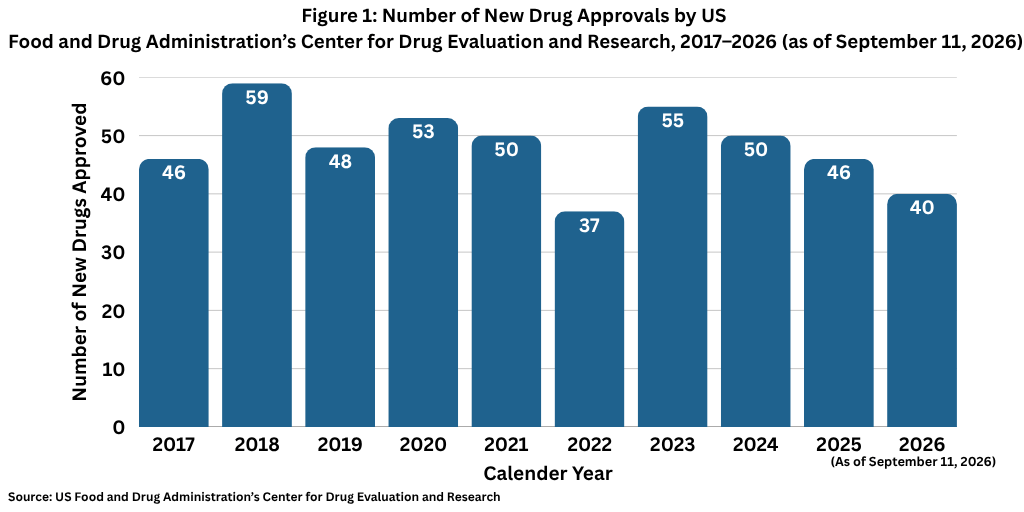
As the industry moves close to the final quarter of 2026, how are new drug approvals faring overall in the US? Through September 11, 2026, FDA’s CDER had approved 40 new drugs, which is well above the pace of 2025, when 46 new drugs were approved for the full year (see Figure 1). Although new drug approvals do not follow a chronological path per se, the uptick in the number of new drug approvals thus far in 2026 bodes well as a measure of product innovation. As a year-to date comparison, using the end of September as a mark, 32 drugs had been approved at that point in time in 2025, 34 in 2024 (en route to 50 new drug approvals for the full year), 40 in 2023 (en route to recent high of new drug approvals of 55 for the full year), 26 in 2022 (en route to a recent low in full-year approvals of 37) and 40 in 2021 (en route to 50 new drug approvals for the full year).
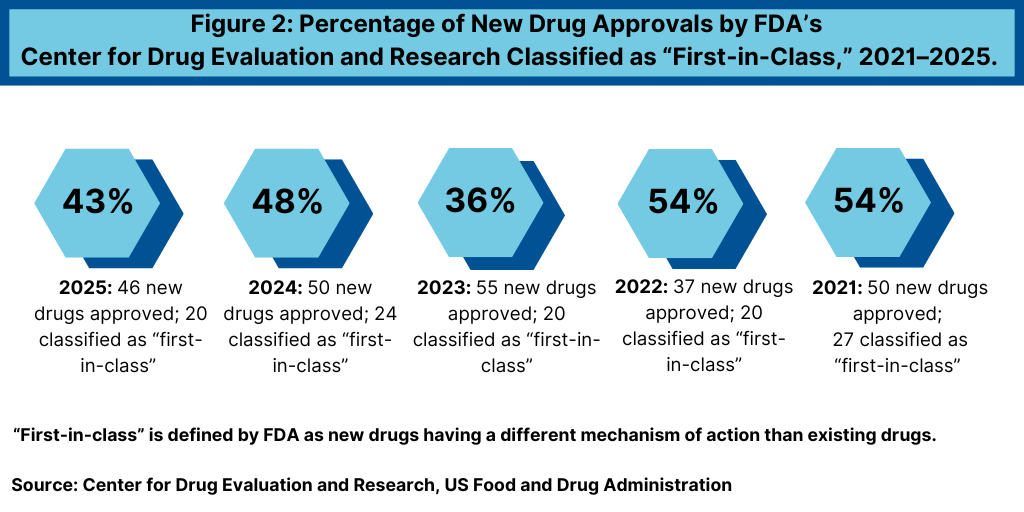
Aside from the total number of approvals, how novel have those drug approvals been? One measure is to look at the percentage of new drug approvals that were classified by FDA as being “first-in-class,” referring to a drug with new mechanism of action different from existing therapies. Using that as a criterion helps to distinguish between first-in-class drugs and so-called “me-too” drugs, which are structurally and functionally similar to an original, first-in-class drug already approved and sold on the market. As a percentage of overall new drug approvals in 2025, only 43% were classified as first-in-class, down from 48% in 2024 but up from a recent low of 36% in 2023 (see Figure 2).
On a product mix level, the number of NDA approvals far exceeds the number of BLA approvals by FDA’s CDER in 2025 for drugs classified as first-in-class. Of the 20 first-in-class new drug approvals in 2025, 16 (80%) were approved as NDAs (i.e., small-molecule drugs/chemically synthesized drugs) and four (20%) were approved as BLAs. Also, reflecting the trend to precision medicines, of the 20 first-in-class new drug approvals in 2025, 11 or 55% received orphan drug designation by FDA; an orphan disease is a rare disease or condition that affects fewer than 200,000 people in the US.
First-in-class new drug approvals: the companies and products
Among the large bio/pharmaceutical companies, Sanofi led the way with first-in-class new drug approvals in 2025 with two, and AbbVie, Bayer, Boehringer Ingelheim, GSK, Novartis, and Otsuka each had one.
Sanofi’s Qfitlia (fitusiran) was approved as the first antithrombin-lowering siRNA therapy to prevent or reduce the frequency of bleeding episodes in hemophilia A or B with or without factor VIII or IX inhibitors. Sanofi co-developed fitusiran with Alnylam Pharmaceuticals. Sanofi also received approval for Wayrilz (rilzabrutinib), an oral reversible Bruton’s tyrosine kinase inhibitor that decreases immune-mediated platelet destruction. It is used to treat persistent or chronic immune thrombocytopenia that has not sufficiently responded to immunoglobulins, anti-D therapy, or corticosteroids
AbbVie was granted accelerated approved by FDA for Emrelis (telisotuzumab vedotin-tllv), an antibody drug conjugate (ADC) for treating a certain form of locally advanced or metastatic non-squamous non-small cell lung cancer (NSCLC). Specifically, the drug was approved for patients with metastatic, non-squamous NSCLC with high c-Met protein overexpression who have received a prior systemic therapy. Emrelis is AbbVie’s first internally developed solid tumor medicine, its first solid tumor FDA approval in lung cancer, and its second FDA-approved ADC. Its other commercial ADC, Elahere (mirvetuximab soravtansine-gyxn) for treating ovarian cancer, was gained by its $10.1-billion acquisition of ImmunoGen in early 2024.
Bayer gained approval for Lynkuet (elinzanetant), a dual neurokinin (NK) targeted therapy, neurokinin 1 (NK1) and neurokinin 3 (NK3) receptor antagonist, for the treatment of moderate-to-severe hot flashes due to menopause. Boehringer Ingelheim received approval for Jascayd (nerandomilast) to treat progressive pulmonary fibrosis (PPF), a rare lung disease. Jascayd is a phosphodiesterase 4B (PDE4B) inhibitor with immunomodulatory and antifibrotic effects approved in this indication.
GSK got the FDA nod in 2025 for Blujepa (gepotidacin), an oral antibiotic for treating uncomplicated urinary tract infections. It was later approved in 2025 also for treating uncomplicated urogenital gonorrhea. It is a bactericidal, first-in-class triazaacenaphthylene antibiotic that inhibits bacterial DNA replication by a distinct binding site, a novel mechanism of action, and for most pathogens, provides inhibition of two different Type II topoisomerase enzymes. This provides activity against Neisseria gonorrhea and most target uropathogens (such as Escherichia coli and Staphylococcus saprophyticus), including isolates resistant to current antibiotics.
Novartis received FDA approval for Rhapsido (remibrutinib) for treating chronic spontaneous urticaria (CSU) (i.e. chronic hives) in adults who remain symptomatic despite H1 antihistamine treatment. It is an oral Bruton’s tyrosine kinase inhibitor and marked the first approval of a Bruton’s tyrosine kinase inhibitor for CSU and introduced an oral option for patients whose symptoms are not adequately controlled with antihistamines.
Otsuka received approval for Voyxact (sibeprenlimab-szsi), a monoclonal antibody for reducing proteinuria (i.e., high levels of protein in the urine) in primary immunoglobulin A nephropathy (a chronic kidney condition) in adults at risk for disease progression.
First-in-class approvals from mid-sized and small pharma companies
Mid-sized and small innovator companies also had first-in-class drug approvals by FDA’s CDER in 2025. CSL received FDA approval for Andembry (garadacimab-gxii) for preventing attacks of hereditary angioedema, a rare genetic disorder causing swelling. It competes with Takeda’s blockbuster drug, Takhzyro (lanadelumab-flyo), and BioCryst Pharmaceuticals’ Orladeyo (berotralstat) and potentially with a first-in-class drug approved in 2025 for the same indication, Ionis Pharmaceuticals’ Dawnzera (donidalorsen).
Alcon received approval for Tryptyr (acoltremon) for treating the signs and symptoms of dry-eye disease, representing its first FDA approval for a prescription drug since being spun off from Novartis in 2019. Vertex Pharmaceuticals got the FDA nod for Journavx (suzetrigine), an oral, selective, non-opioid NaV1.8 pain signal inhibitor for treating adults with moderate-to-severe acute pain. Through its $935-million acquisition of the bio/pharma company, Chimerix, Jazz Pharmaceuticals received FDA approval for Modeyso (dordaviprone) for treating a rare form of brain cancer, diffuse midline glioma harboring an H3 K27M mutation. UCB also gained a rare-disease drug approval for Kygevvi (doxecitine and doxribtimine) for treating thymidine kinase 2 deficiency in patients who start to show symptoms when they are 12 years old or younger.
Among smaller pharma companies, Arrowhead Pharmaceuticals gained approval for Redemplo (plozasiran) for reducing triglycerides in adults with familial chylomicronemia syndrome, a rare genetic disorder that stops the body from breaking down dietary fats, leading to high triglyceride levels and a high risk of acute pancreatitis. Innoviva Specialty Therapeutics received approval for Nuzolvence (zoliflodacin), an oral antibiotic for treating uncomplicated urogenital gonorrhea. Insemd received FDA approval for Brinsupri (brensocatib) for treating non-cystic fibrosis bronchiectasis, a chronic lung disease. Omeros received approval for Yartemlea (narsoplimab-wuug) for treating hematopoietic stem-cell transplant-associated thrombotic microangiopathy (blood clotting in the small arteries). Mighty Therapeutics (formerly named Stealth BioTherapeutics) received approval for Forzinity (elamipretide) for improving muscle strength in patients with Barth syndrome, a rare genetic disorder. And Verastem received approval for Avmapki Fakzynja Co-Pack (avutometinib and defactinib) to treat KRAS-mutated recurrent low-grade serous ovarian cancer after prior systemic therapy.