

Why Biopharma’s Biggest Challenge May Not Be Geopolitics

The deeper threat to the biopharmaceutical industry may come not from macro-level disruption, but from structural pressures on the industry’s innovation-driven model and the biotech ecosystem that supports it.

Principal, EY-Parthenon Life Sciences, Ernst & Young LLP
By Ashwin Singhania, Principal, EY-Parthenon Life Sciences, Ernst & Young LLP
Biopharma: navigating the challenges
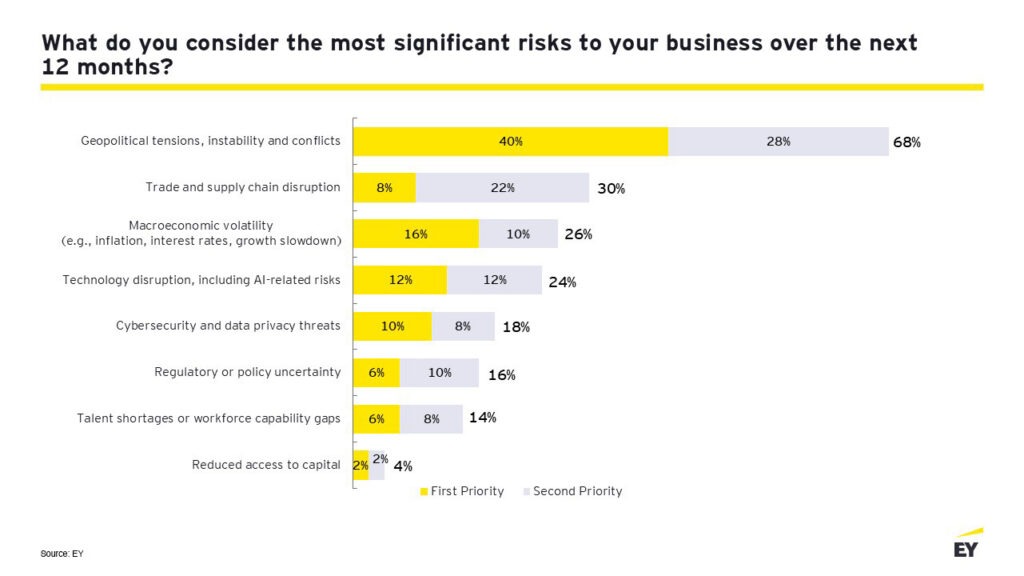
The biopharmaceutical industry experienced an unprecedented series of roadblocks and disruptions last year (2025), from the sudden imposition of global trade tariffs to negotiations with the Trump Administration over most-favored-nation (MFN) pricing. An EY survey of life-sciences leaders placed geopolitical friction at the head of the list of strategic concerns for 2026, followed by supply-chain challenges, and broader macroeconomic volatility (see figure below).
Biopharma: key performance metrics
Yet a review of the industry’s key performance metrics in 2025 and the first half of 2026 suggests that biopharma has largely succeeded in navigating these challenges and is moving forward robustly. The deeper threat to the sector may come not from macro-level disruption, but from structural pressures on the industry’s innovation-driven model and the biotech ecosystem that supports it.
There is no question that policies initiated by the US federal government in 2025 raised the prospect of fundamental change. Within the US, policies—such as the funding cuts to the National Institutes of Health (NIH), as well as potential scaling back of public grants from bodies such as the Biomedical Advanced Research and Development Authority (BARDA)— have raised concerns about the long-term financing environment. NIH grants not only provide funding opportunities but also serve as a signal to venture investors about the scientific credibility of new start-ups. A diminished role for the agency, therefore, has a potentially outsized impact on the domestic innovation ecosystem.
The US Administration’s impact on the sector has also had repercussions far beyond the US itself. Biopharma has become a globalized industry over the past three decades, with its research and manufacturing base distributed worldwide. The tariff initiative announced on the US’s “Liberation Day” in April 2025 had the potential to rewire that model, compelling companies to reconsider the geopolitical risks embedded in their operations.
The most visible response has been a series of pledges by industry leaders to reinvest in US manufacturing sites throughout 2025 and 2026. More structural realignments, such as sourcing active pharmaceutical ingredients and raw materials within US borders, have not yet become a reality.
The Administration’s second major policy initiative also loomed over the foundations of the industry’s business model: pressure to restructure pricing so that the US received “most-favored-nation” treatment in line with comparable wealthy nations. With US pricing serving as the industry’s ultimate guarantee of innovation funding, such a change could have forced profound strategic adjustments.
Nevertheless, biopharma has emerged largely intact from these policy disruptions. Big Pharma companies have been rewarded by the market for their handling of the most-favored-nation negotiations and embarked on a significant mergers and acquisitions (M&A) spree in the first half of 2026. Beyond these major players, however, what is the operating reality for the broader industry and, particularly, for the biotechs that drive its grassroots innovation?
The headline numbers look robust. Revenues in the first half of 2026 are roughly in line with 2025, a year in which 55 US biotechs achieved revenues of US$500 million or more, and the sector’s overall revenues climbed by over 12%.
Innovation in biopharma
This continuing growth is fueled by the scale of innovation the industry supports. At the end of 2025, there were 22,500 biopharma products in development, representing a near-doubling over the previous decade (see figure below). Global pipelines include significant numbers of new-modality products, with cell and gene therapies in clinical development growing at a compound annual rate of 10% since 2020.
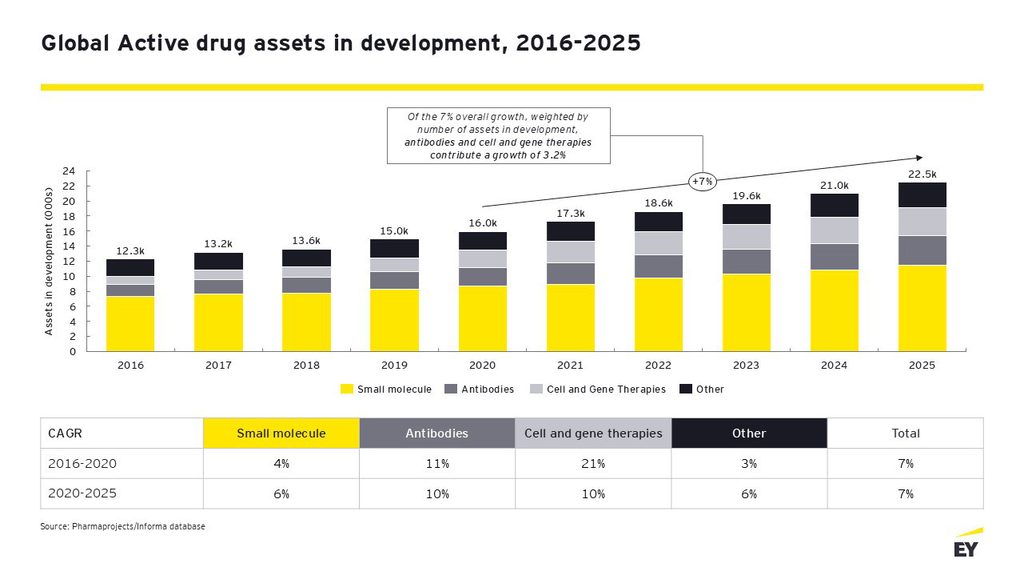
New modalities—not only cell and gene therapies but “armed antibody” formats, such as antibody-drug conjugates, bispecific and multi-specific antibodies, and a new wave of radioconjugate products—have long been regarded as central to the industry’s next phase of growth. In 2026, there is strong evidence that this potential is translating into dealmaking, with more than US$20 billion invested in cell and gene therapies in the first half of the year alone.
Biotech continues to concentrate its spending on innovation. Capital allocation analysis suggests that the sector’s commercial leaders invested around 47% of their deployable capital in R&D during 2025, broadly in line with the five-year average of 50%. By comparison, only 22% was returned to shareholders through dividends and buybacks. Innovation remains biotech’s north star.
The industry’s heavyweight players show the same commitment. Up to one-third of Big Pharma’s expenditures are allocated to R&D, the largest single cost line in companies’ budgets. M&A and debt repayments have each consumed around 19% of expenditure on average over the past five years.
Generics incursion and the growth gap
This commitment reflects the realities of a business model in which the flywheel of product discovery, commercialization, and renewed discovery must offset the constant pressure of patent expiry and generic competition. In 2026, Big Pharma is moving through one of the most significant and protracted patent cliffs in the industry’s history, deploying both R&D and M&A spending to mitigate the resulting revenue erosion.
While this investment is cushioning the immediate impact, longer-term projections suggest that more work is required. Analysis points to a US$370 billion “growth gap” for the leading Big Pharma cohort by 2032, underlining the need to strengthen portfolios and pipelines if companies are to meet their projected growth targets.
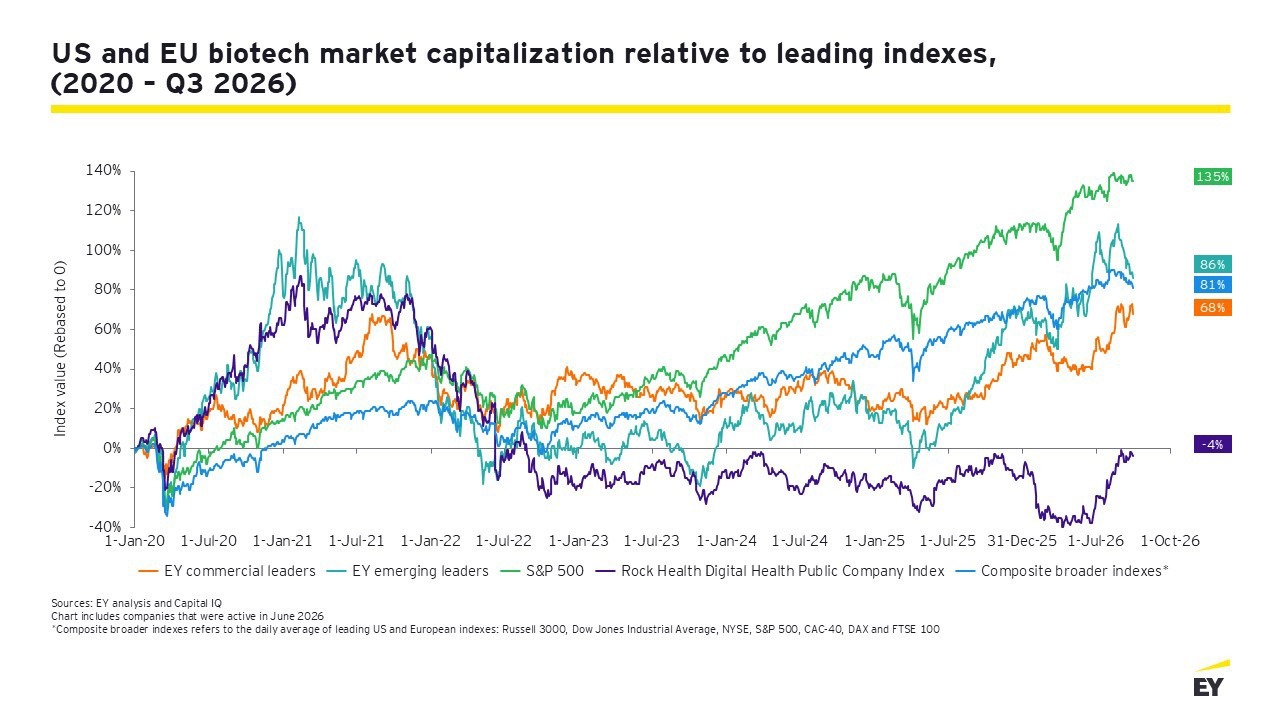
Markets have rewarded biotech for its response to the Trump Administration and the wider macroeconomic disruption. Share prices revived in the second half of 2025, and the recovery continued to gain momentum throughout 2026. Emerging biotechs outperformed broader composite indices over the first 10 months of the year, indicating strong confidence in the continuing health of the ecosystem (see figure below).
Is that confidence misplaced?
Biotech financing trends
The financing landscape has changed considerably since the pandemic peak, when unprecedented volumes of initial public offerings (IPOs) and follow-on offerings allowed biotech to capture more than US$120 billion in financing in both 2020 and 2021. This was a massive, if temporary, surge of investor interest in life sciences as the industry stood on the frontline of the fight against COVID-19.
Since then, annual financing has settled at little over half those peak levels. Between 2022 and 2025, biotech fundraising averaged US$67 billion per year. The figure was US$68 billion in 2025 while the sector raised a further US$58 billion in the first six months of 2026 alone.
The critical question for biotech’s long-term health is how much of this capital is reaching innovative companies at the beginning of their journey. The ability of start-up biotechs to access financing and, eventually, the public markets has underwritten the industry’s success to date.
Of the US$58 billion raised in the first half of 2026, an unusually large share came from debt issued by larger biotechs to finance growth investments. More important to the health of smaller companies is the availability of venture capital, a.k.a., the fuel of early-stage innovation.
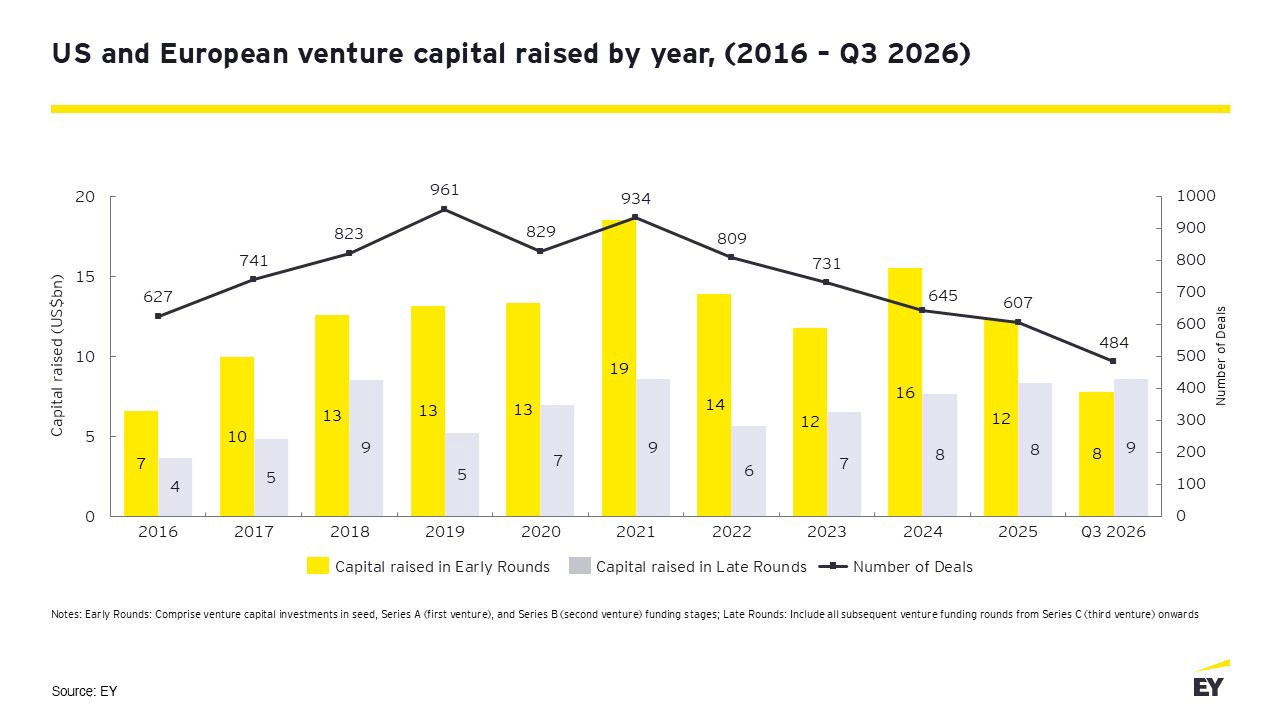
In 2025, venture investment was a robust US$20.6 billion, around two-thirds of the amount raised during the record-breaking influx of 2021. Yet beneath biopharma’s healthy headline figures, there is still a disconcerting rattle that the industry cannot afford to ignore.
The source of that disquiet is the underlying funding landscape in the US and Europe. Although aggregate financing numbers remain impressive, investment is increasingly concentrated. Record-breaking rounds are available for the most sought-after platforms and technologies, but there is limited financial headroom for the many other companies operating in the space.
Only 56% of venture investment in 2025 went to early-stage companies, compared with a five-year average of 67%. That capital was raised through just 354 rounds, 35% below the five-year average volume of early-stage financings. The shift reflects growing risk aversion among biotech investors.
This trend has intensified over the first three quarters of 2026 (see figure below). Of the US$16.4 billion invested in the first nine months of the year, early-stage rounds received only 47%. As financing narrows around a select group of opportunities, the rest of the industry is feeling the constriction. This is reflected in the continuing decline in the number of biotechs listed on US and European stock exchanges, which has fallen each year since the pandemic-era financing boom brought a wave of new companies to market.
For innovative biotechs, the main alternatives to continued venture support are an M&A exit or an IPO. The flourishing M&A market of 2026 resembles the venture landscape: its impressive headline value is being driven less by unusually high deal volume than by a small number of outsized transactions.
IPO activity has also remained muted since 2021. Between 2022 and 2025, there were an average of 22 biotech IPOs per year, compared with 89 IPOs annually during the four years preceding the pandemic. There were faint signs of recovery in the nine months of 2026 with a series of larger offerings raising US$4.6 billion This sum already exceeds the total IPO fundraising for any year since 2021, though it remains modest by historical standards.
The China factor
At the same time, China has emerged as an increasingly important competitor to the traditional US innovation ecosystem. Over the past five years, Chinese companies have become a growing presence in industry alliance deals. In the first half of 2026, an absolute majority of Big Pharma’s potential “biobucks” committed through partnerships flowed toward China (see figure below).
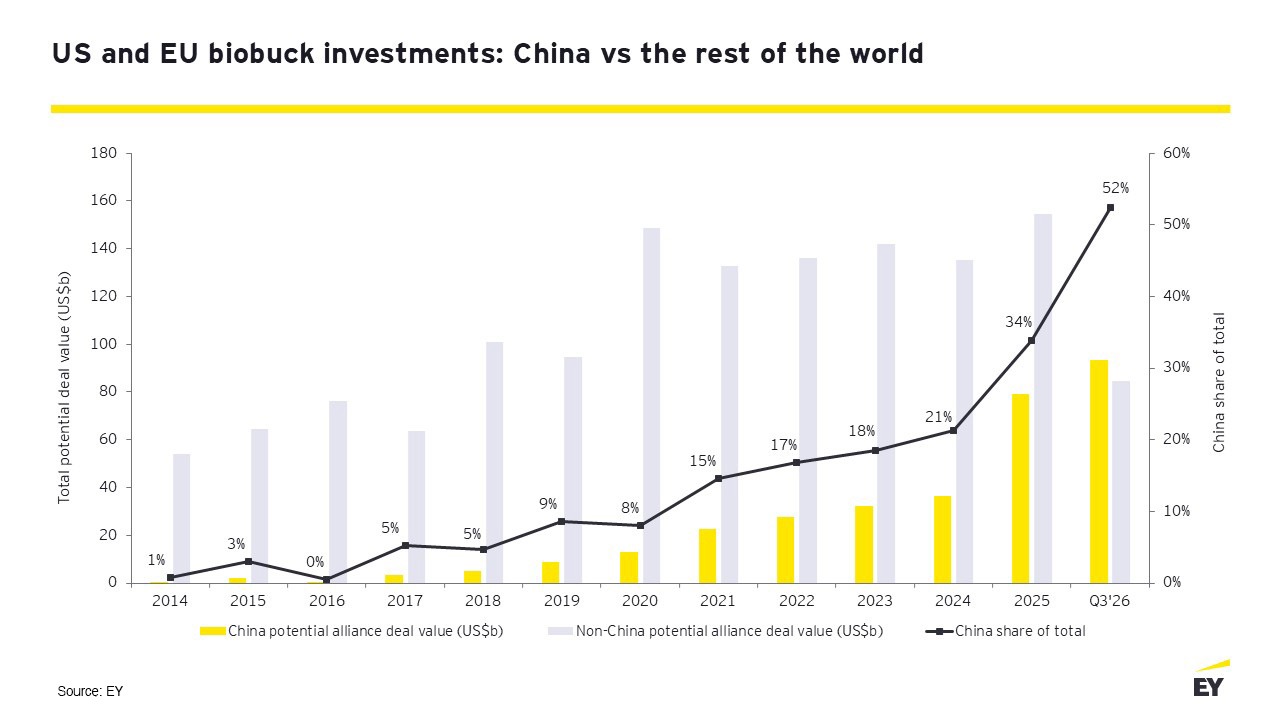
The availability of this alternative source of innovation increases the pressure on US and European biotechs to secure financing. Industry leaders can now access early-stage R&D beyond the traditional ecosystems centered on the Bay Area in California and Boston, Massachusetts, further diluting the investment opportunities available to companies in those markets. While aggregate alliance values continue to soar, China’s rise inevitably limits the scope of opportunity for US and European biotechs.
AI and biopharma
A second, potentially transformative alternative to the traditional biotech model is the use of artificial intelligence (AI) to drive drug innovation, an idea rapidly gaining ascendancy within the industry. Almost 90% of significant biopharma “biobuck” investment in AI targets not back-office streamlining or supply-chain optimization, but the industry’s perennial pain point: R&D. The scale of the opportunity is signaled by the unprecedented financing raised by companies in the field during 2026.
A new model of innovation
The question is, therefore, whether a fundamentally different model of innovation is beginning to take shape—one in which established pharmaceutical companies can source assets from a smaller number of heavily financed platforms, from Chinese innovators or from AI-enabled discovery businesses, rather than relying on a broad and diverse Western biotech ecosystem.
Biopharma’s performance in 2025 and the first three quarters of 2026 demonstrates considerable resilience. The industry has absorbed geopolitical disruption, pricing pressure, and supply-chain uncertainty without sacrificing its commitment to innovation. Revenue growth, pipeline expansion, dealmaking and market performance all support a broadly positive assessment.
However, these aggregate indicators risk concealing a growing structural weakness. Capital is becoming concentrated in fewer companies and larger transactions, early-stage financing is losing ground, IPO markets remain constrained, and new sources of innovation are competing with the traditional US and European biotech base.
Therefore, the immediate outlook may be healthy while the longer-term foundations become less secure. The industry’s central challenge is not simply to maintain the total volume of investment, but to preserve the breadth of the ecosystem from which future medicines emerge. Without sufficient financial oxygen for early-stage companies, biopharma may find that its innovation engine continues to run — but with fewer routes to the discoveries on which its future growth depends.
The views reflected in this article are the views of the author and do not necessarily reflect the views of Ernst & Young LLP or other members of the global EY organization.