

J&J Aims To Be $100-Bn Company; Begins Supply-Chain Restructuring

Johnson & Johnson is aiming to cross the $100-billion revenue mark in 2026 and is beginning a multi-year supply-chain restructuring program in its Innovative Medicine segment.
By Patricia Van Arnum, Editorial Director, DCAT, [email protected]
Targeting to be $100-billion company in 2026
Driven by growth in its oncology franchise and rebounding from biosimilar competition of its once top-selling drug, Stelara (ustekinumab), an anti-inflammatory drug, Johnson & Johnson (J&J) estimates that the company will pass the $100-billion revenue mark in 2026 for the first time in the company’s history with projected combined revenues of $101.1 billion (midpoint range estimate) in its Innovative Medicine (bio/pharmaceuticals business) and MedTech business segments. The company also announced that it has begun a multi-year supply-chain restructuring program of up to $750 million in its Innovative Medicine business as it proceeds with its previously announced $55-billion US capital expansion plan across the company. The company provided the updates as part of its second-quarter 2026 earnings release this week (July 15, 2026).
“With raised guidance and quarterly sales surpassing $25 billion, we are on track to meet our 2026 target of more than $100 billion in annual revenue for the first time in our Company’s 140-year history,” said Joaquin Duato, J&J’s Chairman and CEO, in a July 15, 2026, statement, in announcing the company’s second-quarter 2026 results.
J&J posted second-quarter 2026 sales of $25.31 billion, a 6.6% increase year over year. Its Innovative Medicine segment had second-quarter 2026 revenues of $16.38 billion, or 65% of total sales, a 7.8% increase year over year, and first-half 2026 sales of $31.81 billion, a 9.4% increase year over year. The company’s other business segment, MedTech, posted sales of $8.93 billion in the second quarter of 2026 and $17.56 billion in the first half of 2026.
In its Innovative Medicine segment, J&J is banking on the continued success of Tremfya (guselkumab), an anti-inflammatory drug, as a successor to the company’s once top-selling drug, Stelara (ustekinumab), which faces continued biosimilar competition, and growth in its oncology franchise. Tremfya, a monoclonal antibody and interleukin-23 (IL-23) inhibitor, posted first-half 2026 sales of $3.56 billion, a 70.6% increase year over year. J&J will also be adding to its portfolio for next-generation drugs to Stelara with Icotyde (icotrokinra), an IL-23 receptor antagonist for treating plaque psoriasis and the first and only targeted oral peptide that blocks the IL-23 receptor, according to information from J&J. The drug was approved by the US Food and Drug Administration (FDA) in May (May 2026). Icotyde was jointly discovered and is being developed under a license and collaboration agreement between J&J and Protagonist Therapeutics, a Newark, California bio/pharma company. Icotyde is also being studied in active psoriatic arthritis, moderately-to-severely active ulcerative colitis and moderately-to-severely active Crohn’s disease.
These drugs will offset the revenue losses from Stelara as it continues to face headwinds from biosimilars competition, posting first-half sales of $1.40 billion, a 57.4% decline year over year. In the full-year 2025, Stelara had revenues of $6.08 billion and $10.36 billion in 2024. Like Stelara, Tremfya is approved for treating plaque psoriasis, psoriatic arthritis, Crohn’s disease, and ulcerative colitis.
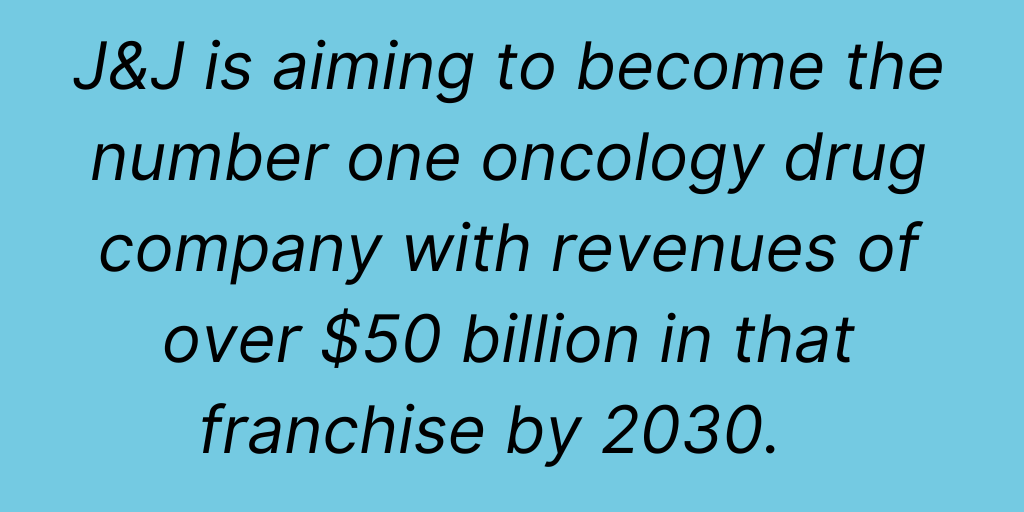
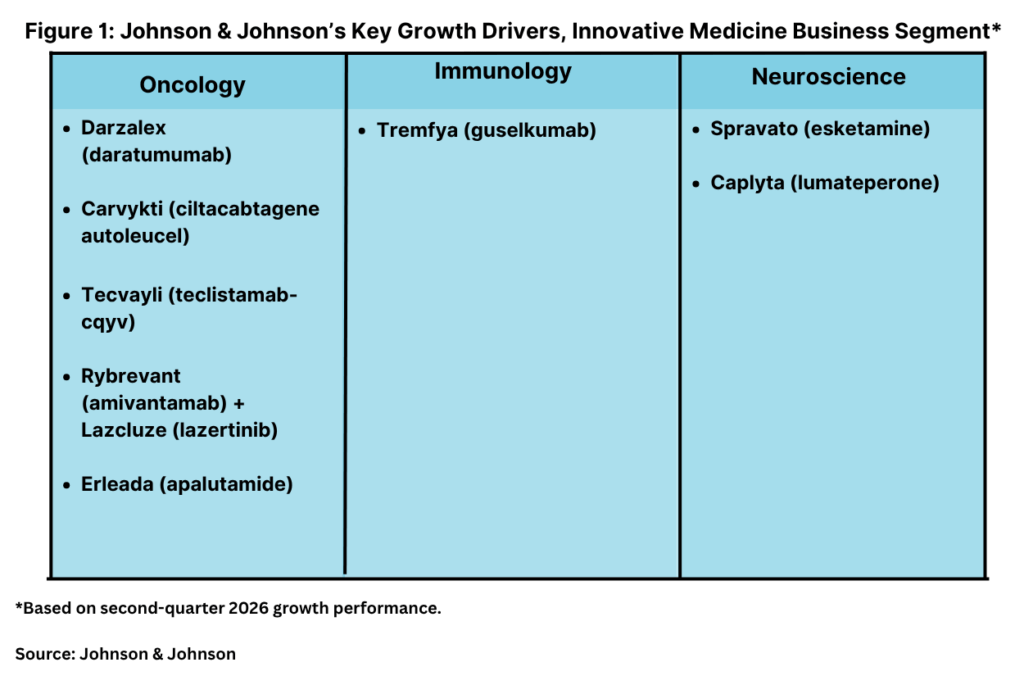
In oncology, J&J’s Duato said that the company is on track to become the number one oncology drug company by 2030 with sales projected to exceed $50 billion. In the first half of 2026, growth in the company’s Innovative Medicine segment was led by its top-selling medicine, Darzalex (daratumumab), a drug for treating multiple myeloma, which posted 2026 second-quarter sales of $4.21 billion (up 18.9% year over year) and first-half 2026 sales of $8.17 billion (up 20.6% year over year). Overall, J&J’s oncology drugs posted first-half revenues of $14.38 billion, representing a 19.9% gain year over year, and accounting for 45% of the company’s Innovative Medicine revenues in the first half of 2026.
Other key performers on a growth basis in oncology were Carvykti (ciltacabtagene autoleucel), a CAR T-cell immunotherapy for treating relapsed or refractory multiple myeloma, with first-half 2026 sales of $1.25 billion, a 55.1% increase year over year; Tecvayli (teclistamab-cqyv), a bispecific immunotherapy for treating relapsed or refractory multiple myeloma with first half 2026 sales of $462 million, up 45.5% year over year; Rybrevant (amivantamab) + Lazcluze (lazertinib), a combination regimen used as first-line therapy for treating locally advanced or metastatic non-small cell lung cancer that have specific EGFR gene mutations, with first half 2026 sales of $546 million, up 70.4% year over year; and Erleada (apalutamide) for treating prostate cancer with first-half 2026 sales of $1.94 billion, up 15.8% year over year.
J&J’s emphasis on its oncology franchise is also seen in recent acquisitions. Last month (June 2026), J&J agreed to acquire Firefly Bio, a South San Francisco, California-based bio/pharmaceutical company specializing in degrader antibody conjugates (DACs) for $1 billion. The acquisition includes Firefly Bio’s proprietary platform for producing DACs, a new modality for cancer treatments, which combines properties of antibody drug conjugates (ADCs) with selective protein degraders to overcome limitations associated with each. Firefly’s proprietary platform uses catalytic protein degraders as the payloads of ADCs, and the company has proprietary linker technology to join these modalities. Firefly Bio debuted as a company with a $94-million financing round in February 2024, which among other investors, included Versant Ventures and Eli Lilly and Company. In announcing the acquisition, J&J noted the potential of the DAC platform for treating KRAS-driven tumors and other solid tumors. The deal is expected to close later this year (2026). Also, in late December 2025, the company completed its $3.05-billion acquisition of Halda Therapeutics, a clinical-stage bio/pharmaceutical company focused on oral therapies for multiple types of solid tumors, including prostate cancer. Halda has a proprietary discovery platform, Regulated Induced Proximity Targeting Chimera (RIPTAC) to enable the modular design of RIPTAC therapeutics as a novel heterobifunctional drug modality for precision cancer treatment.
Outside of oncology, J&J cited key growth performers in the second-quarter 2026 in its neuroscience business, led by Spravato (esketamine), a nasal spray for treating resistant depression or major depressive disorder, which posted first-half 2026 sales of $1.05 billion, a 43.2% gain year over year, and Caplyta (lumateperone), a drug for treating schizophrenia, depressive episodes in bipolar I or II disorder, and major depressive disorder, which posted 2026 first-half sales of $631 million.
Company proceeds with supply-chain restructuring amid US expansions
Without specifying details, J&J reported that in the second quarter of 2026, the company began a supply-chain restructuring program primarily in its Innovative Medicine segment to exit certain manufacturing locations as part of its optimization efforts to streamline operations. The restructuring is occurring as the company proceeds with a previously announced multi-year $55-billion US capital investment plan in manufacturing, research and development, and technology in both its Innovative Medicine and MedTech business segments that is being rolled out through early 2029.
The company said the restructuring program in its Innovative Medicines segment is expected to be substantially completed by the end of fiscal year 2029 with estimated costs between $650 million and $750 million, including site and supplier exit costs, decommissioning, and asset impairment costs. Restructuring expenses of $200 million, primarily related to asset impairments, were recorded in the fiscal second quarter of 2026.
As part of its $55-billion US capital expansion plan, which includes manufacturing in its Innovative Medicine segment, J&J announced in February (February 2026), a more than $1-billion investment to build a new cell-therapy manufacturing facility in Montgomery County, Pennsylvania. The new facility supports the company’s plans to manufacture the vast majority of its advanced medicines in the US for US patients and will further support its pipeline and portfolio for medicines treating cancer, immune-mediated, and neurological diseases. In addition, the company is building a new 500,000-square-foot biologics manufacturing facility in Wilson, North Carolina, which the company started construction of in March 2025. In addition, last August (August 2025), J&J announced a 10-year, $2-billion deal with the CDMO Fujifilm Biotechnologies to secure a 160,000+ square-foot dedicated manufacturing facility at Fujifilm’s new, large-scale biomanufacturing site in Holly Springs, North Carolina.