


Orphan Drugs: The Top Products & Companies
Orphan drug sales are projected to reach a peak of 30% of the global prescription drug market by 2027 and sales of $400 billion by 2032. What products and companies are leading growth?
By Patricia Van Arnum, Editorial Director, DCAT, [email protected]
Snapshot view: orphan drug market
Although a niche area in terms of the patient populations served, orphan drugs are an important part of the growth strategy of both large bio/pharmaceutical companies and smaller companies. Orphan drugs are defined as prescription medicines developed for rare diseases and conditions, which, in the US, affect fewer than 200,000 people, or, in the European Union, affect five people per 10,000 people.
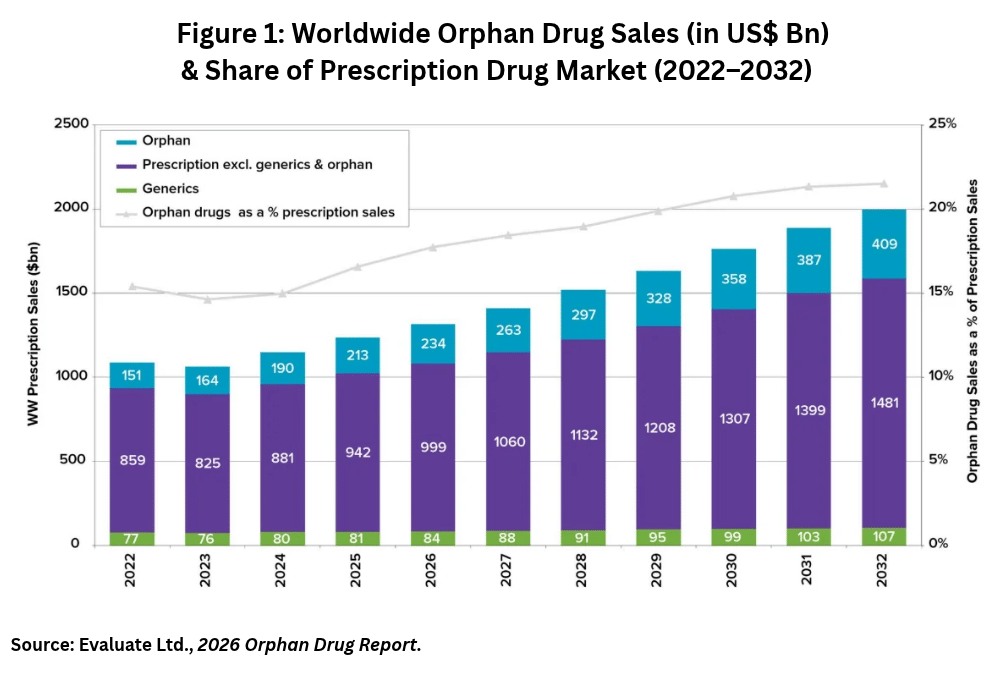
Orphan drug sales are forecast to exceed $400 billion by 2032, accounting for more than a fifth (22%) of the almost $1.9 trillion projected global prescription drug market in 2032, according to a recent analysis, the 2026 Orphan Drug Report: A Safe(r) Passage Amid Stormy Waters by Evaluate Ltd., a business intelligence firm serving the bio/pharmaceutical industry. That reflects an uptick in market share of orphan drugs in the global prescription drug market, which was 15% in 2022, according to the Evaluate analysis. However, orphan drugs’ share of overall prescription drugs sales is expected to fall over the next seven years, from a projected peak of 30% in 2027 to 22% in 2032 (see Figure 1), primarily due to key competition from non-orphan drugs. “This likely reflects growing interest and investment in big drugs for big diseases, including most prominently GLP-1 based therapies, [which are] fast expanding beyond diabetes/obesity into cardiovascular, autoimmune and other conditions, [including] Eli Lilly’s oral GLP-1, orforglipron [which was approved by FDA in April 2026], which is projected to sell almost $20 billion in 2032, providing a significant boost to non-orphan drug sales,” according to the Evaluate Ltd. analysis.
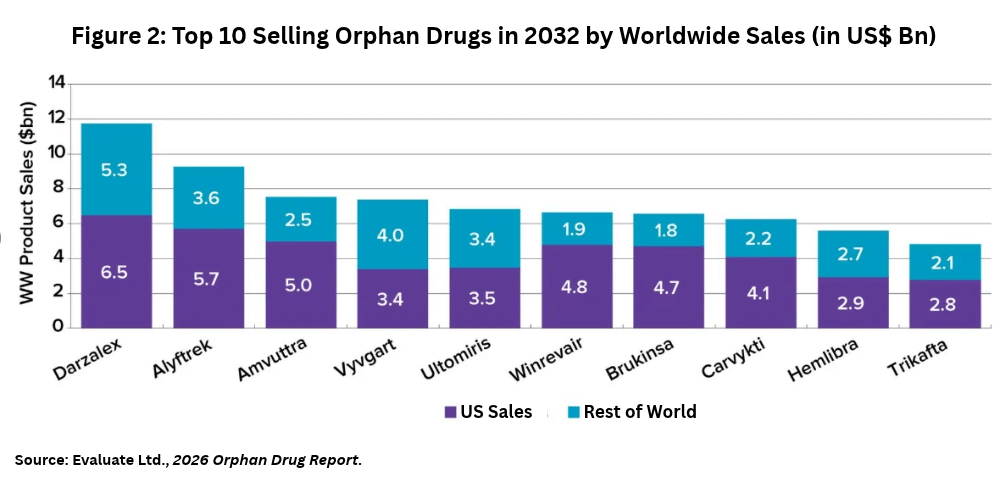
Looking at the top-selling orphan drugs in 2032, eight are projected not only to reach and exceed blockbuster status (defined as products with sales of $1 billion or more) but are also projected to reach worldwide sales of over $6 billion each in 2032 (see Figure 2). The leading forecast orphan drug is Johnson & Johson’s Darzalex (daratumumab) for treating multiple myeloma, with projected 2032 sales of $11.8 billion, according to the Evaluate analysis.
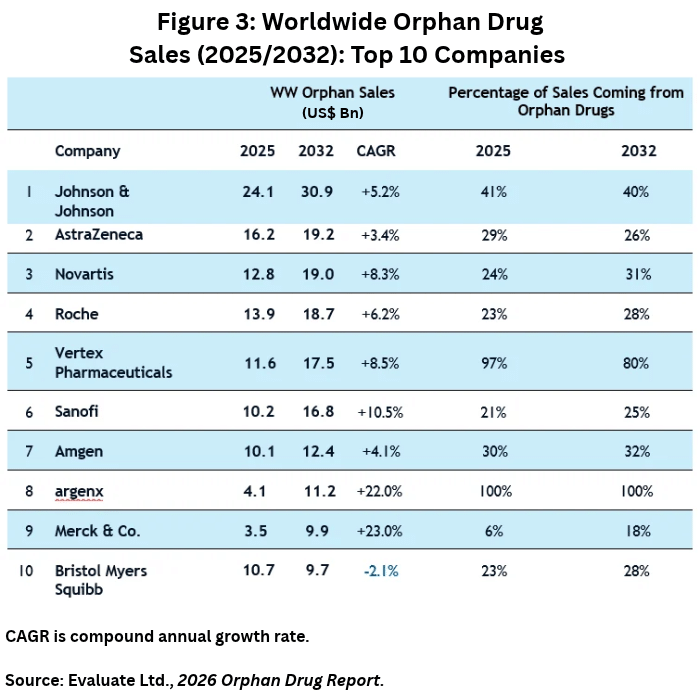
Led by Darzalex, J&J is projected to be the market leader in orphan drug sales, with almost $31 billion in projected orphan drug sales in 2032, followed by AstraZeneca, Novartis, Roche, Vertex Pharmaceuticals, Sanofi, argenx, Merck & Co., and Bristol-Myers Squibb (see Figure 3).
Argenx breaks into the top 10 companies in orphan drug sales, with Vyvgart (efgartigimod alfa) and subcutaneous Vyvgart Hytrulo in myasthenia gravis and other rare auto-immune disorders with projected sales of $11 billion in 2032, ahead of Merck & Co. and Bristol Myers Squibb, according to the Evaluate analysis. The other non-Big Pharma company in the top 10 is Vertex Pharmaceuticals, led by its once-daily cystic fibrosis drug, Alyftrek (vanzacaftor/tezacaftor/deutivacaftor), with forecast sales of $9 billion by 2032, and Vertex’s predecessor drug, Trikafta (elexacaftor/tezacaftor/ivacaftor), taken twice-daily, with projected 2032 sales of $4.5 billion.
Merck & Co. is the only top 10 company expected to match argenx’ anticipated 20%-plus compound annual orphan sales growth rate between 2025 and 2032, according to the Evaluate analysis with the pulmonary hypertension drug, Winrevair (sotatercept), projected to top $6.5 billion in 2032 sales. Next-fastest in growth rates in orphan drug sales is Sanofi, with 10.5% forecast growth by several orphan products, led by the coagulation factor VIII replacement therapy, Altuviio, which is forecast to top $3 billion by 2032, according to the Evaluate analysis.
Orphan drug sales for Bristol Myers Squibb are projected to decline over the next six years as Revlimid (lenalidomide), for treating several blood cancers, faces patent and orphan exclusivity defenses. BMS’ newer orphan drug, Reblozyl (luspatercept-aamt) for treating beta thalassemia-associated anemia, and CAR-T cell therapy, Breyanzi (lisocabtagene maraleucel) for treating lymphoma are each anticipated to sell over $3 billion in 2032, but won’t fully fill the revenue gap, according to the Evaluate analysis.
Orphan drugs: pipeline potential
On a pipeline basis, orphan pipeline candidates are collectively forecast to top $100 billion in 2032. Relacorilant, a glucocorticoid receptor antagonist developed by Corcept Therapeutics for Cushing syndrome (hypercortisolism) and platinum-resistant ovarian cancer (PROC), has projected 2032 sales of over $3.5 billion, but the drug faced certain setbacks. In December 2025, FDA rejected the drug’s Cushing application due to insufficient evidence of efficacy and ongoing concerns over liver-related safety. However, positive Phase III survival data published early this year (2026) in PROC, plus an anticipated FDA decision for this indication in July 2026, continue to prop up overall sales forecasts for the drug, which is also being investigated in earlier-stage ovarian cancer and other solid tumors, according to the Evaluate analysis.
Another orphan drug to watch is daraxonrasib, a small-molecule pan-RAS inhibitor developed by Revolution Medicines, which uses several mechanisms to target multiple RAS mutations, including those found in most pancreatic tumors and which was approved by FDA in August (August 2026). Evaluate projects 2032 sales of $4 billion. Other noteworthy pipeline candidates include: Gilead Sciences’ autologous CAR-T cell therapy, anito-cel hits, which Gilead acquired in a $7.8-billion deal that closed earlier this year (2026), and AbbVie’s CD3xBCMA, a bispecific antibody for treating multiple myeloma.
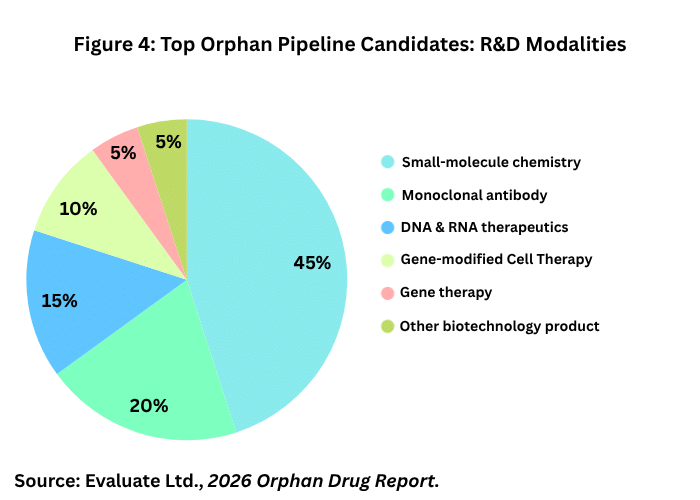
In terms of modalities in the industry’s pipelines, small molecules make up almost half of the top most valuable orphan pipeline candidates despite accounting for just three of today’s top-selling marketed orphan drugs (see Figure 4).