

Pharma M&A: The Deals & the Molecules

What have been the key mergers and acquisitions by the large and mid-sized pharma companies thus far in 2026? DCAT Value Chain Insights evaluates the deal-making and the molecules involved.
By Patricia Van Arnum, Editorial Director, DCAT, [email protected]
M&A thus far in 2026
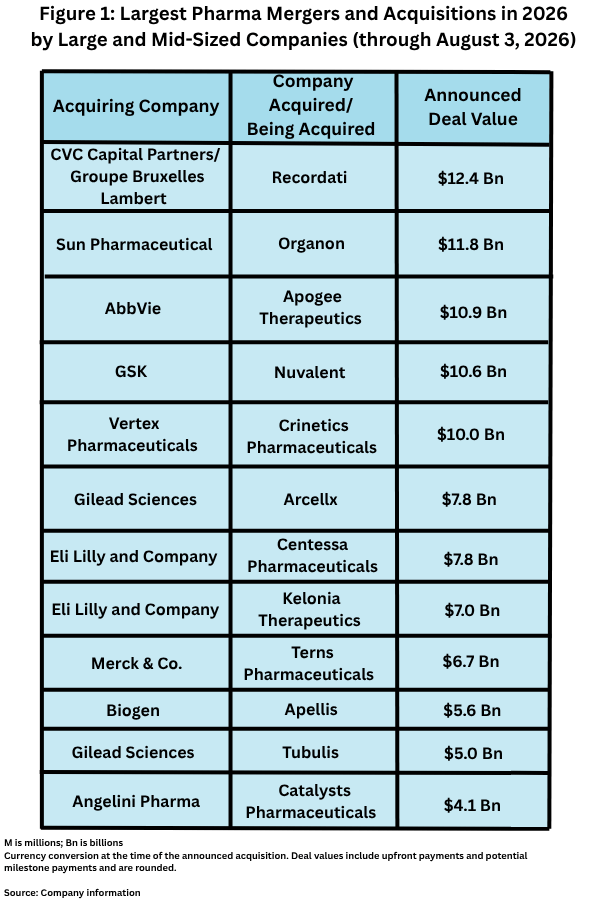
Mergers and acquisitions (M&A) thus far in 2026 show a range of modalities and therapeutic targets by the large bio/pharma companies. However, the two largest acquisitions thus far in 2026 were not from the large pharma companies but were more targeted strategy moves by mid-sized companies: a pending EUR 10.7-billion ($12.4-billion) acquisition by two private equity firms, CVC Capital Partners and Groupe Bruxelles Lambert, to take Recordati, a Milan, Italy-based bio/pharmaceutical company, private and the pending $11.75-billion acquisition by Sun Pharmaceutical, a Mumbai, India-based pharmaceutical company, of Organon & Co., the former women’s health, biosimilars, and established brand business of Merck & Co., which was spun off as an independent company in 2021 (see Figure 1).
Recordati has a portfolio of prescription (primary and specialty care) and self-medication treatments across a range of therapeutic areas. The company has recently focused on expanding its rare-diseases portfolio. It also supplies active pharmaceutical ingredients through its chemicals business. The deal is expected to close in the fourth quarter of 2026, subject to certain closing conditions. For Sun Pharma, primarily a generics company, Organon’s portfolio includes more than 70 products across women’s health and general medicines, which includes biosimilars. The move to acquire Organon is aligned with Sun Pharma’s strategy of growing its Innovative Medicines business, which is focused in dermatology, oncology, and ophthalmology. Upon closing, the combined company would have combined revenues of $12.4 billion with Sun Pharma’s Innovative Medicines accounting for 27%. The deal is expected to close in early 2027.

Moves by the bio/pharmaceutical majors
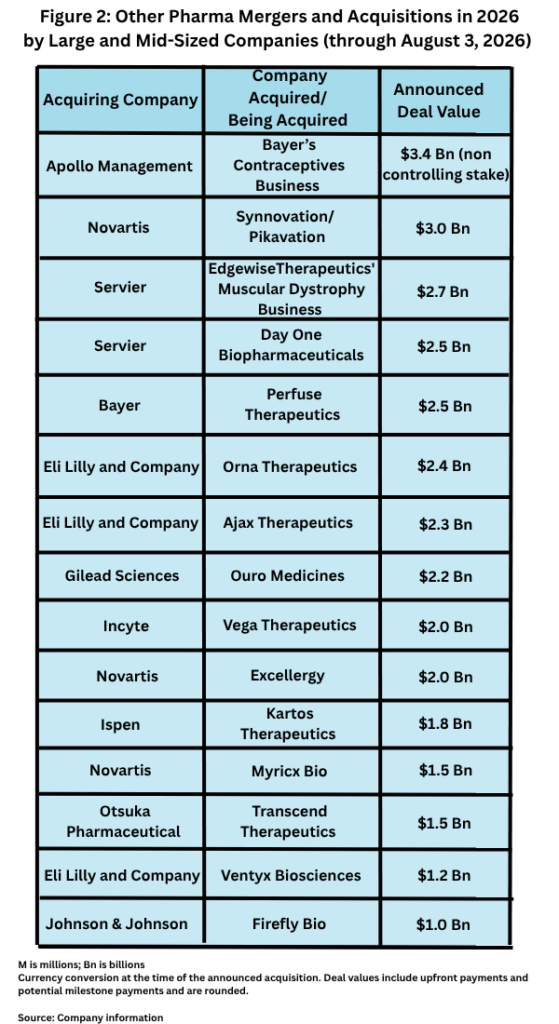
Among the large companies, key acquisitions announced thus far include: AbbVie’s $10.9-billion acquisition of Apogee Therapeutics; GSK’s $10.6-bilion acquisition of Nuvalent; Merck & Co.’s $6.7-billion acquisition of Terns Pharmaceuticals; and multiple moves by Eli Lilly and Company ($7.8-billion acquisition of Centessa Pharmaceuticals, $7.0-billion-acquisition of Kelonia Therapeutics, $2.4-billion acquisition of Orna Therapeutics, $2.3-billion acquisition of Ajax Therapeutics, and $1.2-billion acquisition of Ventyx Biosciences), Gilead Sciences ($7.8-billion acquisition of Arcellx, $5.0-billion acquisition of Tubulis, and $2.2-billion acquisition of Ouro Medicines) and Novartis ($3.0-billion acquisition of a breast cancer drug of Pikavation Therapeutics, $2.9-billion acquisition of Excellergy, and $1.5-billion acquisition of Myricx Bio) (see Figures 1 and 2). A look at these deals show the range of modalities: small molecules, biologics, and cell therapies that were the target of these deals.
AbbVie. AbbVie’s $10.9-billion acquisition of Apogee Therapeutics nets AbbVie two biologic drug candidates in inflammatory and immunological indications. Apogee’s lead assets are zumilokibart, a subcutaneous half-life extended monoclonal antibody for treating atopic dermatitis (eczema) in Phase II development, and APG273, a combination of zumilokibart and APG333, an antibody that blocks thymic stromal lymphopoietin, a signaling protein that acts as an early trigger of inflammation in the lungs. APG273 is in Phase I development for treating asthma. Zumilokibart targets IL-13, a critical cytokine in Type 2 inflammation in diseases such as atopic dermatitis and asthma. Beyond zumilokibart, Apogee has a broader pipeline of antibodies targeting multiple validated inflammatory pathways. The deal is expected to close in the third quarter of 2026, subject to customary closing conditions.
GSK. GSK’s $10.6-bilion acquisition of Nuvalent provides GSK with a pipeline of small molecules that are designed to overcome the limitations of existing therapies for clinically proven kinase targets. Nuvalent’s main assets are zidesamtinib and neladalkib, respectively two late-stage ROS1 and ALK inhibitors for treating non-small cell lung cancer (NSCLC). Both assets have received US Food and Drug Administration (FDA) Breakthrough Therapy and Orphan Drug Designations and are in review with a target FDA decision dates of September 18, 2026, for zidesamtinib, and November 27, 2026, for neladalkib. Subject to FDA approval, they are expected to launch in 2026. Nuvalent’s third asset, NVL-330, is a HER2 inhibitor currently in Phase I trials for treating HER2-altered NSCLC. The deal closed last month (July 2026).
Merck & Co. Merck & Co.’s $6.7-billion acquisition of Terns Pharmaceuticals adds to the company’s oncology drug portfolio. Terns’ lead candidate, TERN-701, is an investigational oral small-molecule drug for treating chronic phase chronic myeloid leukemia (CML). Specifically it is an allosteric BCR::ABL1 tyrosine kinase inhibitor (TKI) currently being evaluated in a Phase I/II trial for patients with Philadelphia chromosome-positive (Ph+), chronic phase CML previously treated with at least one prior TKI and who experienced treatment failure, suboptimal response, or treatment intolerance. In March 2024, the US Food and Drug Administration granted Orphan Drug Designation for TERN-701 for the treatment of CML. The deal was completed in May (May 2026).
Lilly. Lilly has been the most active large pharma company on the M&A front with multiple acquisitions thus far in 2026 to build its pipeline across several modalities. Its $7.8-billion acquisition ($6.3 billion upfront and $1.5 billion in milestone payments) of Centessa Pharmaceuticals provides Lilly with drug candidates for treating sleep–wake disorders. Centessa is advancing a pipeline of orexin receptor 2 (OX2R) agonists designed to address the neurobiological system critical to the sleep-wake cycle to treat excessive daytime sleepiness and disorders of impaired wakefulness. Its lead investigational candidate, cleminorexton, is an oral, selective small-molecule agonist of OX2R in Phase IIa clinical studies across type 1, narcolepsy type 2, and idiopathic hypersomnia. Centessa’s OX2R agonist portfolio includes additional clinical and preclinical-stage assets with potential utility across a broader range of neurological, neurodegenerative, and neuropsychiatric conditions.
Two other acquisitions by Lilly involve genetic medicines, specifically in vivo cell therapies, which seek to overcome clinical and manufacturing challenges associated with ex vivo cell therapies. Ex vivo approaches involve extracting a patient’s cells, modifying or engineering them outside the body, and then reinfusing them into the patient with the cell therapy. For in vivo cell therapies, the patient’s own body serves as the manufacturer of the cell therapy by engineering cells inside the body to eliminate the complex external manufacturing, hospital conditioning, and costs associated with traditional cell therapies. Unlike traditional CAR T therapies that require cell harvesting, engineering and reinfusion, in vivo cell therapies are delivered via a single intravenous infusion and eliminate the need for preconditioning chemotherapy and complex cell processing.
One of the larger acquisitions by Lilly in 2026 is its $7-billion acquisition of Kelonia Therapeutics (Boston), a clinical-stage bio/pharmaceutical company specializing in in vivo gene delivery. With the acquisition, Lilly gains Kelonia’s proprietary in vivo gene-placement system, iGPS, which uses specially engineered lentiviral-based particles designed to enter T-cells inside the body to allow the patient to generate chimeric antigen receptor T-cell (CAR-T) therapies. The in vivo gene delivery technology uses an advanced lentiviral vector particle harboring envelope modification to improve in vivo gene-transfer efficiency and tropism molecules to facilitate tissue-specific delivery. Kelonia’s lead program, KLN-1010, currently in Phase I development for relapsed/refractory multiple myeloma, is an investigational, one-time intravenous therapy that generates anti-B-cell maturation antigen (BCMA) CAR-T cells, targeting the BCMA protein expressed on the surface of multiple myeloma cells.
Lilly’s $2.4-billion acquisition of Orna Therapeutics also involves in vivo cell therapies. Orna is advancing a class of therapeutics using engineered circular RNA paired with lipid nanoparticles to allow the patient’s own body to generate cell therapies that can treat underlying disease. Orna’s lead program is ORN-252, a clinical trial-ready, CD19-targeting in vivo CAR-T therapy designed to treat B cell-driven autoimmune diseases. Experiments to date suggest that Orna’s circular RNA platform may deliver more durable expression of therapeutic proteins and therefore provide treatments that are not feasible with current RNA or cell therapy platforms, according to information from Lilly.
Separately in biologics, earlier this year, Lilly agreed to acquire three vaccine companies for a combined $3.8 billion: Curevo ($1.5 billion), LimmaTech Biologics ($780 million), and Vaccine Company ($1.5 billion). Curevo’s lead product candidate is amezosvatein, an adjuvanted subunit vaccine for the prevention of shingles in adults. LimmaTech Biologics is developing vaccines against bacterial pathogens, including Staphylococcus aureus, Neisseria gonorrhoeae, and Chlamydia trachomatis. LimmaTech’s lead program, LTB-SA7, is in Phase I development as a vaccine against S. aureus. Vaccine Company has proprietary In Vivo Nanoparticle (IVN) technologies, which are designed to enable the antigen display known to elicit durable immune responses associated with virus-like particle vaccines. The company is advancing a broad preclinical pipeline spanning multiple viral pathogens; its lead program applies this technology to Epstein-Barr Virus with a five-antigen Phase I-ready candidate.
Lilly’s $2.3-billion acquisition of Ajax Therapeutics and its $1.2-billion acquisition of Ventyx Biosciences provide Lilly with small-molecule drug candidates. Ajax Therapeutics is developing Janus kinase (JAK) inhibitors for treating myeloproliferative neoplasms, a group of rare, chronic blood cancers. JAK inhibitors are a class of targeted immunomodulatory medications that block specific enzymes (JAK1, JAK2, JAK3, TYK2) to reduce inflammation and manage autoimmune disorders. Ajax’s lead asset, AJ1-11095, is an investigational, once-daily oral small-molecule Type II JAK2 inhibitor currently being evaluated in a Phase I clinical trial with first proof-of-concept clinical data to be presented later in 2026. Ventyx Biosciences is developing a pipeline of small-molecule therapeutics, including NLRP3 inhibitors, for treating inflammation.
Gilead Sciences. Gilead Sciences’ acquisitions involved biologics—cell therapies and bispecific T-cell engager antibodies and antibody drug conjugates (ADCs). Gilead Sciences’ $7.8-billion acquisition (includes both upfront and contingent milestone payments) of Arcellx nets the company anitocabtagene autoleucel, an investigational CAR T-cell therapy for multiple myeloma. Gilead’s $5.0-billion acquisition ($3.15 billion upfront and $1.85 billion in milestone payments) of Tubulis provides the company with investigational ADCs for treating solid tumors. Tubulis’ lead asset, TUB-040, is currently in Phase Ib/II development for treating platinum-resistant ovarian cancer and non-small cell lung cancer. It is a NaPi2b-directed topoisomerase-I inhibitor ADC. Gilead also gains TUB-030, a 5T4-targeted ADC, which has initial clinical data across various solid tumor types. Gilead Sciences’ $2.2-billion acquisition ($1.7 billion upfront and $500 million in milestone payments) of Ouro Medicines, which is developing T cell engager therapies for autoimmune diseases, provides Gilead with gamgertamig, a clinical‑stage bispecific T-cell engager antibody for treating severe antibody-mediated orphan diseases, including autoimmune hemolytic anemia and immune thrombocytopenia.
Novartis. Novartis has made three acquisitions in 2026: a $3.0-billion acquisition ($2 billion upfront and $1 billion in milestone payments) for a breast cancer drug from Pikavation Therapeutics (a subsidiary of Synnovation Therapeutics), a $2.9-billion acquisition of Excellergy, and a $1.5-billion acquisition of Myricx Bio.
With Pikavation/Synnovation, Novartis gains SNV4818, an oral small-molecule drug currently being evaluated in a Phase I/II study for breast cancer and other advanced solid tumors. It is a pan-mutant-selective PI3Kα inhibitor that targets advanced solid tumors and HR+/HER2- metastatic breast cancer carrying PIK3CA mutations. The acquisition of Excellergy, which is developing anti-immunoglobulin E (IgE) therapies for IgE-driven diseases, is part of Novartis immunology strategy in food allergy and other IgE-driven diseases.
Myricx is developing ADCs using N-myristoyltransferase inhibitor (NMTi) payloads, which are designed to address limitations of commonly used ADC payload classes such as TOPO-1 inhibitors. NMT is an enzyme that helps proteins function inside cells, which is essential for how cancer cells grow and survive, and by inhibiting NMT, the payload is designed to disrupt processes that cancer cells rely on. Preclinical data suggest the NMTi payload may have broad activity across solid tumors, including TOPO-1 resistant models, and may enable more effective use of ADCs in settings where existing payload classes have limitations, according to information from Novartis. The acquisition would give Novartis the opportunity to help establish NMTi, if clinically validated, as a new class of ADC payloads that could be applied across additional targets and platforms. Myricx is developing two lead assets directed toward the targets, B7-H3 and HER2, with potential across multiple solid tumor settings.