

Incentivizing US-Based Contract Biomanufacturing

The Biotechnology Innovation Organization (BIO) is recommending a seven-point action plan to increase US competitiveness in biotech, including incentives for increasing US-based contract biomanufacturing.
By Patricia Van Arnum, Editorial Director, DCAT, [email protected]
Seven-point action plan for US biotech competitiveness
The Biotechnology Innovation Organization (BIO), which represents the biotechnology industry in the US, issued a seven-point action plan to call on policymakers to strengthen US competitiveness in biotech, including ways to stimulate bio/pharmaceutical product development and biomanufacturing in the US.
“For decades, American biotechnology innovators have turned scientific discovery into hope for patients and families, building an industry that saves lives, drives economic growth, and strengthens our nation’s security and competitiveness,” said John F. Crowley, President and CEO of BIO, in a November 10, 2026, press statement. “In doing so, America’s biotechnology innovators have built one of our nation’s greatest strategic assets. But our leadership is not guaranteed. We must invest, innovate, and act with urgency.”

The plan, called BioAdvance: Securing America’s Biotech Century, calls for a coordinated national strategy and targeted policy reforms to accelerate medical breakthroughs, strengthen the innovation ecosystem, and increase US-based biomanufacturing, including contract biomanufacturing. Part of the impetus behind the plan, noted BIO, is to more effectively compete again China as a rising force in the global landscape, where it says the country launches more than a quarter of clinical trials globally and runs early-stage clinical trials in a more timely and cost-effective manner comparative to the US.
Figure 1 outlines BIO’s recommendations. Chief among them is a call to establish a White House Office of Biotechnology, which would lead a coordinated national biotechnology strategy, strengthen US competitiveness, align policy across agencies, and track progress against strategic competitors.
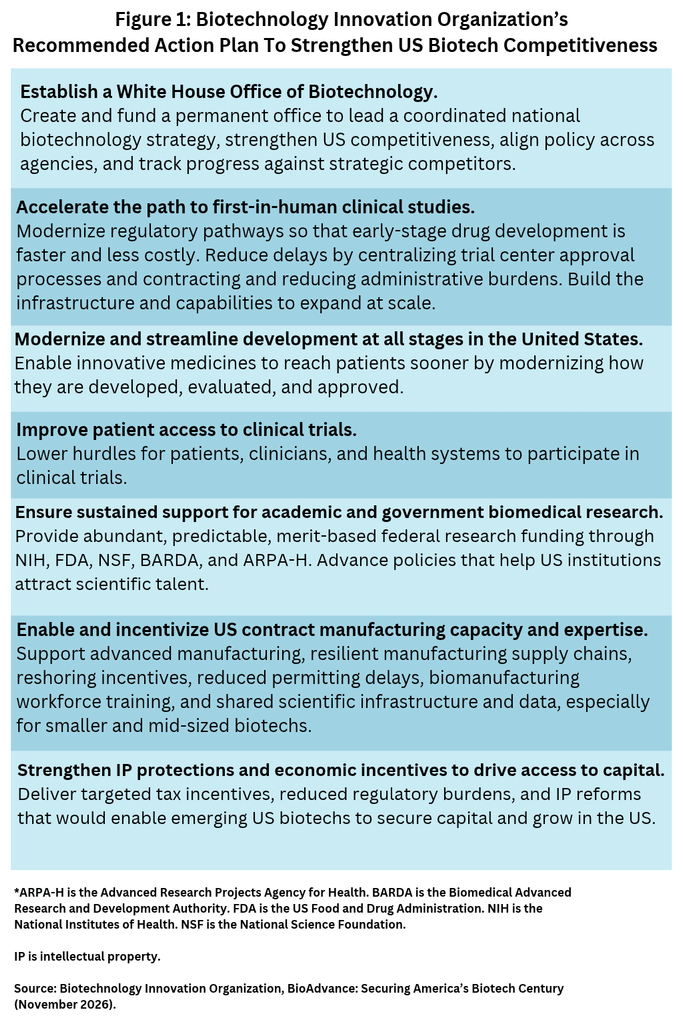
Several measures call for facilitating clinical trials in the US by accelerating the path to first-in-human clinical studies, facilitating the participation of patients, clinicians, and health systems in clinical trials, and overall modernizing how medicines are developed, evaluated, and approved.
The plan also calls for providing “abundant, predictable, merit-based federal research funding” through US government entities, including the National Institutes of Health, the US Food and Drug Administration, the Biomedical Advanced Research and Development Authority, the National Science Foundation, and the Advanced Research Projects Agency for Health, as well as advancing policies that help US institutions attract scientific talent.
In addition, the plan calls for measures to strengthen intellectual property protection and provide economic and tax incentives that would enable emerging US biotechs to secure capital and grow in the US.
Another important part of BIO’s recommended action relates to biomanufacturing, including facilitating and incentivizing US-based contract manufacturing capacity and expertise. These recommendations include measures supporting advanced manufacturing, building more resilient manufacturing supply chains, reshoring incentives, reducing permitting delays, facilitating biomanufacturing workforce training, and developing shared scientific infrastructure and data, especially for the benefit of smaller and mid-sized biotechs.
A plan for US-based biomanufacturing, including contract biomanufacturing
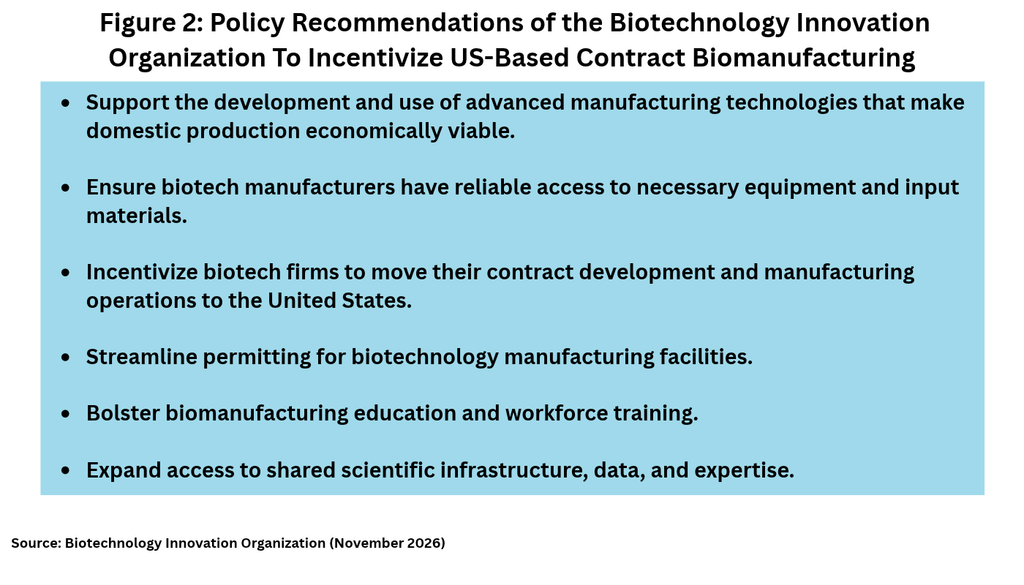
BIO mapped out six key actions for US policymakers to take to building US-based biomanufacturing, including contract biomanufacturing, as a means to support bio/pharmaceutical development and commercialization (see Figure 2).
“To maintain its global leadership and protect American interests, the United States must be able to compete at every stage of the innovation process—from early clinical development through commercial-scale manufacturing,” said BIO in its action plan. “That will require a more robust and resilient network of US and allied clinical sites, contract development and manufacturing organizations (CDMOs), equipment suppliers, and trained workers. Smaller and earlier-stage biotechnology companies, in particular, depend on CDMOs for facilities, specialized equipment, technical expertise, and regulatory support…Policymakers should use targeted tax incentives and funding to expand domestic CDMO capacity and help American biotech entrepreneurs scale their companies here at home.”
BIO’s recommendation for strengthening US-based biomanufacturing are outlined below.
Advanced manufacturing, pilot-scale production, and reshoring. BIO is calling on US policymakers to support the development and use of advanced manufacturing technologies that make domestic production economically viable, including continuous manufacturing, greener chemistry, automation, process improvements, AI-enabled quality systems, and other approaches that reduce cost and improve reliability. It is also calling on the US government to incentivize the construction of integrated manufacturing campuses that can handle multiple stages of production, which would include providing grants, tax incentives, credit tools, and direct funding for pilot-scale facilities to encourage broader adoption of these emerging technologies and facilitating reshoring production into the US.
US-based access to equipment and input materials. BIO is calling on the US government to establish a National Strategic Biomanufacturing Priority List that identifies long-lead equipment and input materials important to US competitiveness and implement clearer funding mechanisms, tax credits, and priority procurement for domestic suppliers of these resources.
Incentivize US-based CDMO operations. BIO is calling on policymakers to facilitate onshoring of biomanufacturing of CDMO operations by addressing the cost and logistical difficulties of relocating CDMO operations domestically. To ease and encourage a transition from the use of ex-US CDMOs to US-based CDMOs, BIO is recommending that policymakers should provide targeted incentives, such as tax credits for technology transfer, additional forms of capital, extended patent terms and regulatory exclusivity, and federal procurement commitments, to offset the costs companies may face as they transfer their development and manufacturing pipelines.
Streamline permitting for biotechnology manufacturing facilities. BIO says policymakers should address ways to streamline and accelerate environmental review processes for new biomanufacturing capacity in the US through increased cooperation among federal, state, and local governments to do so.
Bolster biomanufacturing education and workforce training. BIO is calling on federal and state governments to work with universities, community and technical colleges, workforce organizations, and industry to establish clear pathways into biomanufacturing careers. These approaches would include two-year degree programs and flexible, stackable credentials aligned with cGMP standards and other support for biomanufacturing training.
“Standardized, government-endorsed credentials would help companies confidently identify workers with relevant skills while enabling employees to move more easily among biotechnology employers and regional hubs,” said BIO in its report. “Policymakers should also complement these educational pathways with practical training opportunities. Greater federal funding for tuition assistance, earn-and-learn apprenticeships, and hands-on instruction at pilot-scale facilities would help new workers enter the field while accelerated certificate and retraining programs would allow scientists, engineers, and technicians to add manufacturing and regulatory skills to their existing expertise”
Expand access to shared scientific infrastructure, data, and expertise. BIO also is seeking to address the financial limitations that small biotech companies face to build advanced laboratories, manufacturing facilities, biobanks, or clinical-trial networks. It is calling on federal policymakers to establish clear, standardized partnership agreements that let companies access federal laboratories, regulatory-science expertise, public clinical infrastructure, pilot-scale manufacturing facilities, and specialized equipment. It is also calling on the US government to work with industry and research institutions to develop secure, interoperable, and AI-ready biological and manufacturing data to facilitate broad data sharing, particularly for the benefit of small biotechs, to make large datasets available for drug discovery, development, and manufacturing.