


Mid-Year Review: What’s Trending in New Drug Approvals?
FDA’s Center for Drug Evaluation and Research has approved 24 new drugs thus far in 2026. Which companies and drug candidates have crossed the finish line, and how is the product mix between small molecules and biologics faring?
By Patricia Van Arnum, Editorial Director, DCAT, [email protected]
Taking stock at the mid-year mark
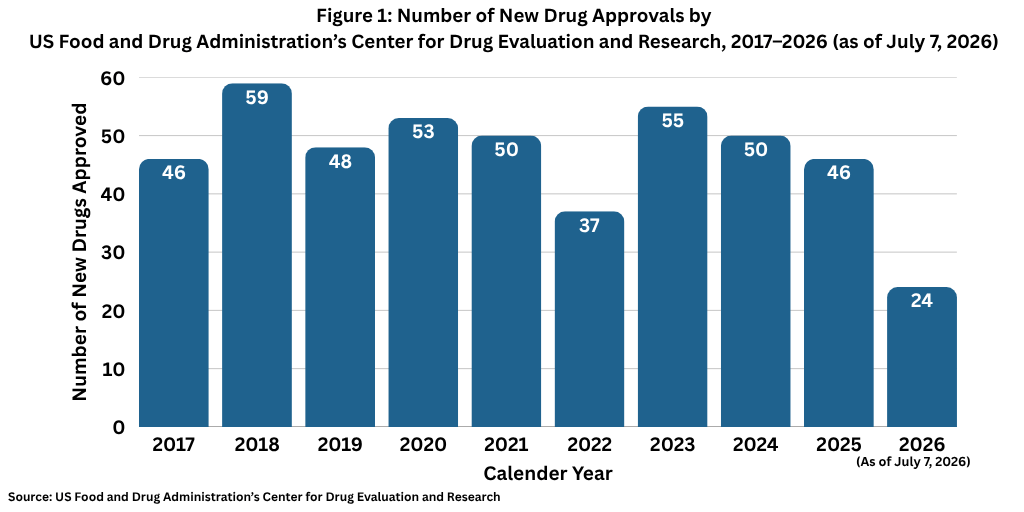
As the industry crossed the mid-year mark, what is the take on the number of new drug approvals in the US? Through July 7, 2026, FDA’s Center for Drug Evaluation and Research (CDER) had approved 24 new molecular entities and biological therapeutics, up from 19 new drugs approved at the mid-way mark in 2025, which had 46 new drug approvals for the full-year. The mid-year mark of 24 new drug approvals in 2026 is on par with earlier levels in 2024 and 2023. At the mid-year mark in 2024, FDA’s CDER had approved 22 new molecular entities and biological therapeutics en route to 50 new drug approvals in the full-year, and 26 new drug approvals at the mid-year mark in 2023, when 55 new drugs were approved in the full year (see Figure 1).
Product mix: NDAs versus BLAs
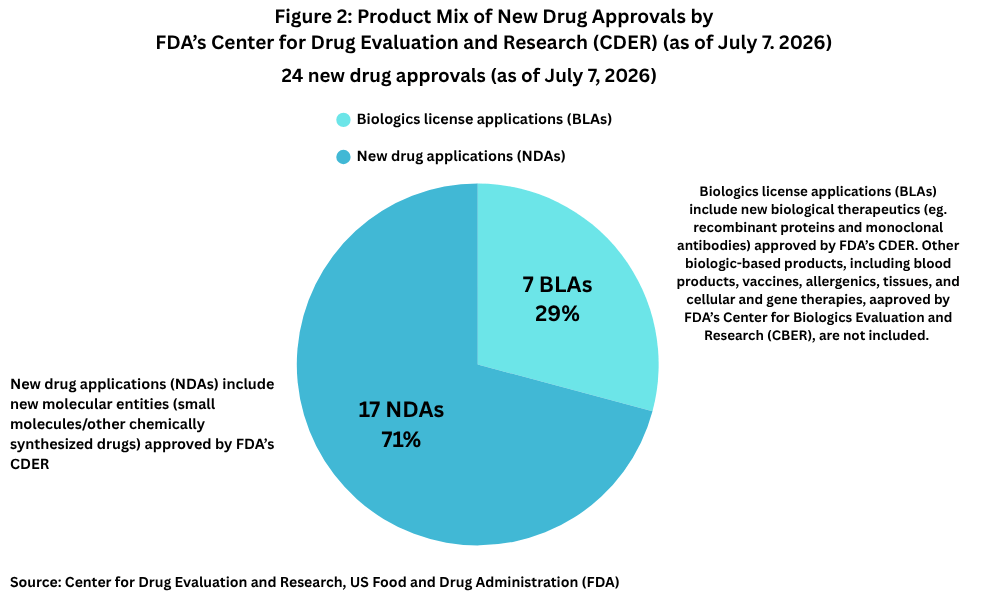
Keeping to recent trends, new molecular entities (small-molecule drugs/chemically synthesized drugs) approved under new drug applications have accounted for the majority of new drug approvals by FDA’s CDER. CDERs reviews and approves new molecular entities under new drug applications (NDAs) and new biological therapeutics (eg., recombinant proteins, monoclonal antibodies and other antibodies) under biologics license applications (BLAs). Other biologic-based products, including blood products, vaccines, allergenics, tissues, and cellular and gene therapies, are reviewed and approved by a separate center within FDA, the Center for Biologics Evaluation and Research (CBER) and are not part of this analysis.
Thus far in 2026, NDA approvals have accounted for 71% of CDER’s approvals and BLAs 29% (see Figure 2). This is on par with the full-year 2025 when CDER approved 46 new drugs, with 34 new molecular entities approved (74%) and 12 biologics approved (26%).
Companies and products getting the FDA nod
Which companies and products have made the regulatory cut thus far in 2026? Ten large bio/pharmaceutical companies have scored a regulatory win at the mid-year mark with GSK gaining two new drug approvals, and AbbVie, AstraZeneca, Bayer, Eli Lilly and Company, Gilead Sciences, Johnson & Johnson (J&J), Merck & Co., Novo Nordisk, and Pfizer (through partnerships) each with a new drug approved by FDA’s CDER (see Table 1 at end of article).
Perhaps the most noteworthy new drug approval thus far in 2026 comes from Eli Lilly and Company with an addition to its obesity drug portfolio with the approval of Foundayo (orforglipron), an oral obesity drug approved by FDA in April (April 2026) and in late-stage development for treating Type 2 diabetes. Foundayo is a once-daily small-molecule (non-peptide) oral glucagon-like peptide-1 (GLP-1) receptor agonist (RA). Analysts project blockbuster potential (defined as sales of $1 billion or more) for the drug with the oral administration being a key driver for revenue potential. In a recent analysis, Clarivate projects sales of orforglipron of $11.1 billion for obesity in 2031 in the G7 markets (Canada, France, Germany, Italy, Japan, the UK, and the US) and $5.2 billion in expected sales for Type 2 diabetes in the G7 markets in 2031. Orforglipron is the first oral, non-peptide, small-molecule GLP-1 RA to be approved. It can be taken without food or water restrictions at any time of the day. As such, it represents a breakthrough in convenience and accessibility compared with injectable alternatives, according to the Clarivate analysis.
Foundayo joins Lilly’s blockbuster diabetes/obesity franchise already riding the blockbuster wave with Mounjaro/Zepbound (tirzepatide), a dual-activating GIP (glucose-dependent insulinotropic polypeptide) and GLP-1 medication, respectively for treating Type 2 diabetes and obesity. Mounjaro’s first-quarter 2026 revenues were $8.7 billion, and Zepbound reached revenues of $4.2 billion.
Lilly’s chief competitor in the diabetes/obesity market is Novo Nordisk, with its GLP-1 drugs, Ozempic/Wegovy (semaglutide), respectively for treating Type 2 diabetes and obesity. Novo Nordisk added to its diabetes franchise with FDA approval in March (March 2026) of Awiqli (insulin icodec-abae), the first FDA-approved once-weekly basal (i.e., long-acting) insulin for adults with Type 2 diabetes. It is designed as an alternative to daily basal insulin dosing.
In oncology, the largest therapeutic sector in the global bio/pharmaceutical industry, there were several new drugs approved in 2026 from the large bio/pharma companies. Pfizer and Arvinas received approval for Veppanu (vepdegestrant), the first FDA-approved PROTAC (proteolysis targeting chimera) protein degrader approved for estrogen receptor 1 (ESR1)-mutated advanced breast cancer. Last month (June 2026), Rigel Pharmaceuticals entered into an exclusive, global license agreement with Arvinas and Pfizer to develop, manufacture, and commercialize Veppanu with Rigel responsible for the launch and commercialization of Veppanu in the US and owning global rights with the ability to sub-license to potential partners to further develop and commercialize Veppanu outside of the US.
AbbVie received approval for Decnupaz (pivekimab sunirine), a CD123-targeting antibody-drug conjugate (ADC) for treating blastic plasmacytoid dendritic cell neoplasm, a rare hematologic malignancy. Outside of the large bio/pharma companies, BeOne Medicines received FDA approval for Beqalzi (sonrotoclax), a BCL-2 inhibitor used to treat adult patients with relapsed or refractory mantle cell lymphoma, a rare and aggressive form of B-cell non-Hodgkin lymphoma.
In immunology, J&J received FDA appoval for Icotyde (icotrokinra), a once-daily oral peptide and interleukin-23 (IL-23) receptor antagonist for treating moderate-to-severe plaque psoriasis. It is positioned as a potential successor to J&J’s blockbuster drug, Stelara (ustekinumab), which faces biosimilars competition. In 2025, global sales of Stelara declined to $6.08 billion, representing approximately a 41% decline year-over-year. Stelara is indicated for treating moderate-to-severe plaque psoriasis, active psoriatic arthritis, moderately to severely active Crohn’s disease, and moderately to severely active ulcerative colitis.
AstraZeneca has hopes for its new drug, Baxfendy (baxdrostat), representing a new class of medicines called aldosterone synthase inhibitors (ASI), for treating hypertension, The drug was approved in May (May 2026) for treating hypertension in combination with other antihypertensive medications, to lower blood pressure in adults whose blood pressure is not adequately controlled. Baxfendy is an ASI designed to lower blood pressure in a new way by specifically inhibiting the production of aldosterone, a hormone that raises blood pressure to unhealthy levels and increases the risk of heart and kidney problems, according to information from AstraZeneca. The company projects peak annual sales of more than $5 billion, and some analysts project peak sales of $10 billion globally if approved for other indication for chronic kidney disease and heart failure.
Table 1: Mid-Year Review 2026: New Drug Approvals by FDA’s Center for Drug Evaluation and Research (as of July 7, 2026)
| Company | Branded Name (active pharmaceutical ingredient) | Type of Filing | Indication |
| AbbVie | Decnupaz (pivekimab sunirine-pvzy) | BLA | Blastic plasmacytoid dendritic cell neoplasm, a rare hematologic malignancy |
| Acrotech Biopharma/ Evive Biotech | Adquey (difamilast) | NDA | Mild-to-moderate atopic dermatitis (eczema) |
| Ascendis Pharma | Yuviwel (navepegritide) | NDA | To increase linear growth in pediatric patients 2 years and older with achondroplasia with open epiphyses |
| AstraZeneca | Baxfendy (baxdrostat) | NDA | Hypertension in combination with other antihypertensive drugs |
| Bayer | Ambelvist (gadoquatrane) | NDA | To detect and visualize lesions with abnormal vascularity, in conjunction with MRI |
| BeOne Medicines | Beqalzi (sonrotoclax) | NDA | Relapsed or refractory mantle cell lymphoma |
| Corcept Therapeutics | Lifyorli (relacorilant) | NDA | Platinum-resistant epithelial ovarian, fallopian tube, or primary peritoneal cancer |
| Denali Therapeutics | Avlayah (tividenofusp alfa-eknm) | BLA | Hunter syndrome (Mucopolysaccharidosis Type II) |
| Eli Lilly and Company | Foundayo (orforglipron) | NDA | To reduce excess body weight and maintain weight reduction long term in adults with obesity or adults with overweight in the presence of at least one weight-related comorbid condition |
| Gilead Sciences | Hepcludex (bulevirtide-gmod) | BLA | Chronic hepatitis delta virus infection in adults w/o cirrhosis or with compensated cirrhosis |
| GSK | Utebzi (tebipenem pivoxil) | NDA | Complicated urinary tract infections |
| GSK/Alfasigma* | Lynavoy (linerixibat) | NDA | Cholestatic pruritus (severe itching) associated with primary biliary cholangitis (a rare liver disease) |
| Haisco Pharmaceutical | Cypsedo (cipepofol) | NDA | To induce general anesthesia in adults undergoing surgery |
| Immedica Pharma | Loargys (pegzilarginase-nbln) | BLA | Hyperargininemia (rare liver disease) in adult and pediatric patients 2 years of age and older with Arginase 1 Deficiency |
| Johnson & Johnson | Icotyde (icotrokinra) | NDA | Moderate-to-severe plaque psoriasis |
| Merck & Co. | Dvynso (doravirine and islatravir) | NDA | HIV-1 infection |
| Novo Nordisk | Awiqli (insulin icodec-abae) | BLA | Type 2 diabetes |
| Pfizer/Arnivas/Rigel Pharmaceuticals* | Veppanu (vepdegestrant) | NDA | Estrogen receptor-positive, human epidermal growth factor receptor 2-negative, ESR1-mutated advanced or metastatic breast cancer |
| Sentynl Therapeutics | Zycubo (copper histidinate) | NDA | Menkes disease, genetic disorder affecting the body’s ability to process copper. |
| Shionogi | Xocova (ensitrelvir) | NDA | Post-exposure prophylaxis of coronavirus disease 2019 (COVID-19) |
| Vanda Pharmaceuticals | Bysanti (milsaperidone) | NDA | Schizophrenia and manic or mixed episodes associated with Bipolar I disorder |
| Vera Therapeutics | Trutakna (atacicept-vymj) | BLA | Proteinuria (protein in urine) in adults with primary immunoglobulin A nephropathy |
| Viridian Therapeutics | Lumvoa (veligrotug-vvze) | BLA | Thyroid eye disease |
| Wockhardt | Zaynich (cefepime and zidebactam) | NDA | Complicated urinary tract infections |
*GSK announced in March 2026 a license agreement by which Alfasigma S.p.A. acquires exclusive worldwide rights to develop, manufacture, and commercialize linerixibat.
** Rigel Pharmaceuticals entered into an exclusive, global license agreement with Arvinas and Pfizer to develop, manufacture, and commercialize Veppanu (vepdegestrant) in June 2026. Rigel is responsible for the launch and commercialization of Veppanu in the US and will own global rights with the ability to sub-license to potential partners to further develop and commercialize Veppanu outside of the US. Arnivas and Pfizer had earlier formed an agreement in 2021 for the co-development and co-commercialization of vepdegestrant.
Source: US Food and Drug Administration