


In Vivo Cell Therapies: Solving Mfg Obstacles?

Several bio/pharma majors are making a play in in vivo cell therapies with recent $1-billion-plus acquisitions with an aim for both clinical and manufacturing benefits. Are in vivo cell therapies the up-and-coming segment in advanced therapies?
By Patricia Van Arnum, Editorial Director, DCAT, pvanarnum@dcat.org
In vivo cell therapies: the next generation
Now approaching almost 10 years since the US Food and Drug Administration (FDA) approved the first two chimeric antigen receptor T-cell (CAR-T) therapies in 2017 with Novartis’ Kymriah (tisagenlecleucel) and Yescarta (axicabtagene ciloleucel) by Kite Pharma, now part of Gilead Sciences, a new type of cell therapy, in vivo cell therapies, are attracting the investment dollars of large bio/pharmaceutical companies for both potential clinical and manufacturing benefit over ex vivo therapies.
Ex vivo approaches involve extracting patient cells, modifying or engineering them outside the body, and then reinfusing them into the patient with CAR-T cell therapies, where T-cells are engineered, to target cancer cells as an example. For in vivo CAR T therapies, the patient’s own body serves as the manufacturer of CAR T-cells, and therefore in vivo CAR T therapies have the potential to offer a reduced treatment burden and improved accessibility compared to ex vivo CAR T-cell therapies. By engineering cells inside the body, the in vivo approach aims to eliminate the complex external manufacturing, hospital conditioning, and costs associated with traditional cell therapies. Unlike traditional CAR T therapies that require cell harvesting, engineering and reinfusion, in vivo cell therapies are delivered via a single intravenous infusion and eliminate the need for preconditioning chemotherapy and complex cell processing.
Deal-making and in vivo cell therapies
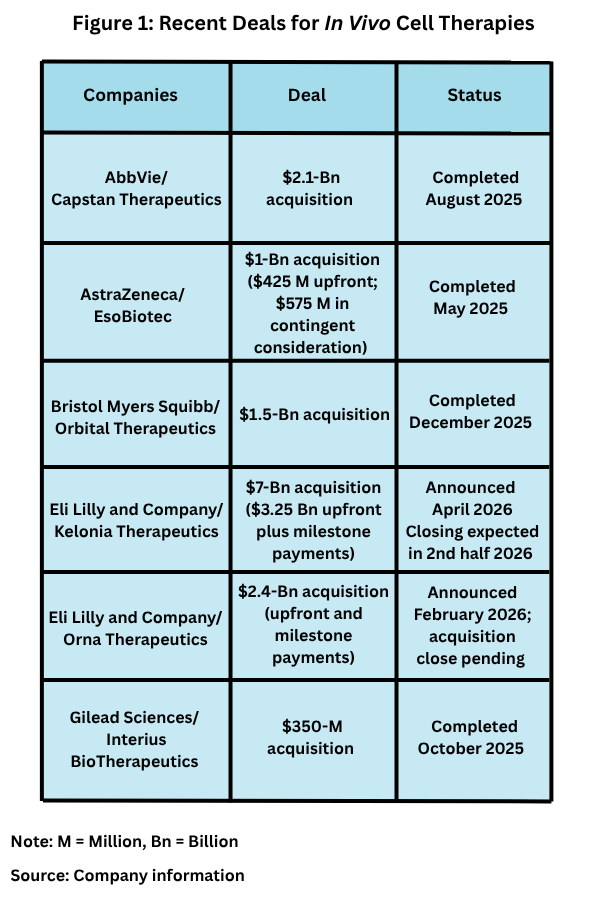
There have been several $1-billion plus deals from large bio/pharmaceutical companies in acquiring smaller companies developing in vivo cell therapies with assets in early-stage development (see Figure 1). One of the largest deals is Eli Lilly and Company’s $7-billion acquisition of Kelonia Therapeutics, a Boston-based clinical-stage bio/pharmaceutical company specializing in in vivo gene delivery. The deal, announced in April (2026), includes $3.25 billion upfront payment and $3.75 billion in milestone payments. Kelonia has developed a proprietary in vivo gene-placement system, iGPS, which uses specially engineered lentiviral-based particles designed to enter T-cells inside the body to allow the patient to generate CAR-T therapies. The in vivo gene delivery technology uses an advanced lentiviral vector particle harboring envelope modification to improve in vivo gene-transfer efficiency and tropism molecules to facilitate tissue-specific delivery. Kelonia’s lead program, KLN-1010, currently in Phase I development for relapsed/refractory multiple myeloma, is an investigational, one-time intravenous therapy that generates anti-B-cell maturation antigen (BCMA) CAR-T cells, targeting the BCMA protein expressed on the surface of multiple myeloma cells.
Lilly is also acquiring Orna Therapeutics, a Watertown, Massachusetts-based early-stage bio/pharmaceutical company, in a $2.4-billion deal (undisclosed upfront payment and milestone payments) that was announced in February (February 2026). Orna is advancing a class of therapeutics using engineered circular RNA paired with lipid nanoparticles (LNPs) to allow the patient’s own body to generate cell therapies that can treat underlying disease. Orna’s lead program is ORN-252, a clinical trial-ready, CD19 targeting in vivo CAR-T therapy designed to treat B cell-driven autoimmune diseases. Experiments to date suggest that Orna’s circular RNA platform may deliver more durable expression of therapeutic proteins and therefore provide treatments that are not feasible with current RNA or cell therapy platforms, according to information from Lilly.
Last August (August 2025), AbbVie completed its acquisition of Capstan Therapeutics, a San Diego, California-based clinical-stage bio/pharmaceutical company, in a deal worth up to $2.1 billion. Capstan’s lead asset, CPTX2309, in Phase I development for the treatment of B cell-mediated autoimmune diseases, is a targeted LNP that generates CD19-specific, CD8+ in vivo CAR-T cells. The CAR-T cells are designed to achieve B cell depletion with the aim of achieving durable, drug-free remission. This can be accomplished without the need for lymphodepleting chemotherapy while also avoiding other challenges associated with conventional ex vivo CAR-T therapies, according to AbbVie. As part of the acquisition, AbbVie acquired Capstan’s proprietary targeted LNP platform technology designed to deliver RNA payloads, such as mRNA, capable of engineering specific cell types in vivo.
Last December (December 2025), Bristol Myers Squibb closed on its $1.5-billion acquisition of Oribital Therapeutics, a Cambridge, Massachusetts-based company. The acquisition included Orbital’s lead RNA immunotherapy preclinical candidate currently in investigational new drug-enabling studies, OTX-201, which comprises an optimized circular RNA encoding a CD19-targeted chimeric antigen receptor for in vivo expression delivered via targeted LNPs. Additionally, BMS acquired Orbital’s proprietary RNA platform, which integrates circular and linear RNA engineering, advanced LNP delivery, and AI-driven design for developing RNA therapies.
Also in 2025 (May 2025), AstraZeneca acquired EsoBiotec, a Mont-Saint-Guibert, Belgium-based biotechnology company specializing in in vivo cell therapies, in a deal worth up to $1 billion ($425 million and $575 million in contingent consideration). The company’s platform, EsoBiotec Engineered NanoBody Lentiviral, uses targeted lentiviruses to deliver genetic instructions to specific immune cells, such as T cells, which program them to recognize and destroy tumor cells for cancer treatment or autoreactive cells for potential use in immune-mediated diseases. The approach enables cell therapies to be administered through a simple IV injection without the need for immune-cell depletion.
In a smaller acquisition in 2025, Kite, part of Gilead Sciences, acquired Interius BioTherapeutics, for $350 million. Interius’ team and operations are now part of Kite’s research team with a center of excellence in Philadelphia for in vivo therapies.