

New CEO Takes the Helm of Takeda: What’s Next?

In a planned succession, Julie Kim took the helm at Takeda as President and CEO with former President and CEO Christophe Weber stepping down following a 12-year tenure. The company faces a transitional period as it seeks to return to growth. What’s the plan?
By Patricia Van Arnum, Editorial Director, DCAT, [email protected]
Changing of the guard
In the final step of its 18-month CEO transition, Takeda announced this week (June 24, 2026) that Julie Kim, formerly President of Takeda’s US Business Unit and CEO-elect, was officially appointed Takeda’s Representative Director, President and Chief Executive Officer (CEO). She takes the helm from former President and CEO Christophe Weber, who retired from the company and the Board.
Kim joined the company in 2019 through Takeda’s $62-billion acquisition of Shire Pharmaceuticals and has held several executive-level roles, including President of the Plasma-Derived Therapies Business Unit and President of the US Business Unit before becoming CEO-elect in 2025.

Kim is taking over Takeda as the company is in a period of transition—a global restructuring program in which the company expects to achieve cost savings of JPY 200 billion ($1.3 billion) annually by fiscal year 2028 and a growth strategy with three near-term expected product launches and five late-stage drug candidates as key drivers.
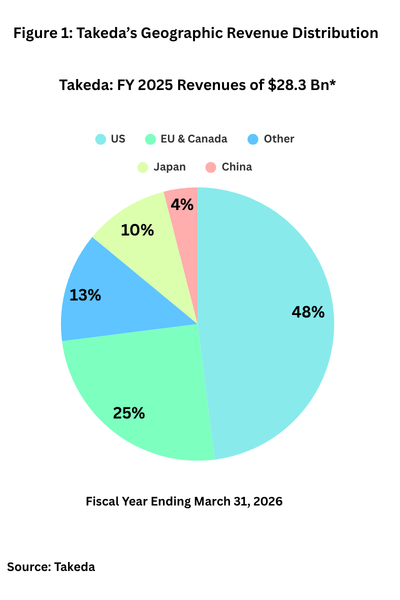
Takeda is seeking to get on track as it reported a slight decline in revenues for fiscal year 2025 (ended March 31, 2026). For fiscal year 2025, the company reported revenues of JPY 4.51 trillion ($28.3 billion) (see Figure 1), a 1.7% year-over-year decrease, largely driven by generic incursion of its blockbuster drug, Vyvanse (lisdexamfetamine), for treating attention deficit hyperactivity disorder and moderate-to-severe binge eating disorder. The company reported a net loss of JPY 152.4 billion ($942 million) primarily as result of recording a provision for legal proceedings of JPY 402.5 billion ($2.5 billion) connected to litigation relating to Amitiza (lubiprostone), its drug for treating constipation.
Takeda’s has six business segments, which account for 95% of the company’s revenues: gastrointestinal, rare diseases, plasma-derived therapies, oncology, vaccines, and neuroscience. Its R&D efforts focus on three core therapeutic areas: gastrointestinal and inflammation, neuroscience, and oncology.
Growth strategy: expected near-term product launches
In the near term, Takeda is banking on three late-stage assets with expected regulatory approvals in the US and other geographies over the next 12–24 months (see Figure 2). These include oveporexton for treating narcolepsy Type 1, a chronic, rare neurological disease characterized by excessive daytime sleepiness and cataplexy (sudden loss of muscle tone); rusfertide for treating polycythemia vera, a rare blood cancer/disorder resulting in the overproduction of red blood cells; and zasocitinib, an oral once-daily pill for treating plaque psoriasis, an immune-mediated inflammatory disease.
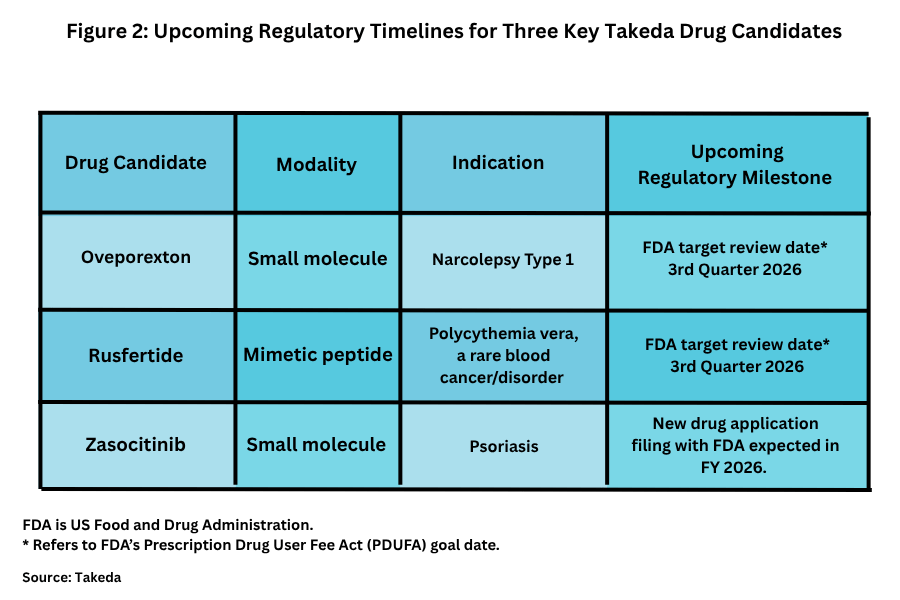
Both oveporexton and rusfertide are slated for review by the US Food and Drug Administration (FDA) in 2026 with a Prescription Drug User Fee Act (PDUFA) goal date in the third quarter 2026. If approved, Takeda says it is planning US commercial launches in the second half of 2026. For zasocitinib, Takeda is planning a regulatory filing in 2026 and, if approved, a commercial launch in the first half of 2027.
Oveporexton, developed in-house by Takeda, is part of the company’s orexin franchise aimed at restoring orexin signaling in a variety of neurological conditions. Other orexin receptor agonists being developed by Takeda include TAK-360, in Phase II development for treating narcolepsy Type 2 and idiopathic hypersomnia, two chronic neurological sleep disorders, and TAK-495 in Phase I development.
Rusfertide is a hepcidin mimetic peptide, discovered by Protagonist Therapeutics, a Newark, California-based bio/pharmaceutical company, and being co-developed with Takeda. In 2024, the companies entered into a worldwide license and collaboration agreement for rusfertide with Protagonist leading development through Phase III studies and Takeda responsible for US and global regulatory filings. Protagonist holds an option to co-commercialize rusfertide in the US through a 50/50 profit-and-loss share structure or can opt-out of the structure to provide Takeda with a worldwide license for the drug.
Zasocitinib is an oral tyrosine kinase 2 (TYK2) inhibitor for treating immune-mediated inflammatory diseases that was discovered and developed by Nimbus Therapeutics, a Boston-based bio/pharmaceutical company. Takeda acquired the zasocitinib program in 2023 as part of its $6-billion acquisition of Nimbus Lakshmi, a subsidiary of Nimbus Therapeutics, developing TYK2 inhibitors. The deal included $4 billion upfront and $2 billion in sales milestone payments–$1 billion each–upon achieving annual net sales of $4 billion and $5 billion of products developed from the zasocitinib program. Takeda is currently evaluating zasocitinib in Phase III studies for treating psoriasis and Phase II studies are underway in Crohn’s disease, ulcerative colitis, vitiligo (an autoimmune condition marked by loss of skin pigment) and hidradenitis suppurativa (a chronic inflammatory skin disease).
Other late-stage candidates
Takeda is also targeting five late-stage drug candidates to drive growth. Mezagitamab is an investigational, fully human anti-CD38 monoclonal antibody developed by Takeda that is currently in Phase III trials for treating primary immune thrombocytopenia, a rare autoimmune blood disorder causing low platelet counts, and IgA nephropathy, a kidney disease where antibodies build up in the kidneys. Additional indications such as renal transplant rejection under evaluation.
Elritercept is in Phase III development for treating very low-, low-, or intermediate-risk myelodysplastic syndromes in individuals with transfusion-dependent anemia, a rare blood cancer. It is also in Phase II development for treating myelofibrosis, a rare blood cancer. Takeda is partnered with Kero Therapeutics, a Lexington, Massachusetts-based clinical-stage bio/pharmaceutical company. In 2024, the companies signed a $1.3-billion deal ($200 million upfront and $1.1 billion) for elritercept with Takeda obtaining an exclusive license to further develop, manufacture, and commercialize elritercept worldwide outside of mainland China, Hong Kong and Macau.
Fazirsiran is an investigational RNA interference (RNAi) therapy in Phase III development for treat alpha-1 antitrypsin deficiency (AATD) associated liver disease, a genetic condition that can cause lung and liver damage. Takeda is partnered with Arrowhead Pharmaceuticals, a Pasanda, California-based bio/pharmaceutical company for fazirsiran.
The company’s other two-late stage candidates are oncology drugs in which Takeda is partnered with Innovent Biologics, a Suzhou, China-based bio/pharmaceutical company, in a pact the companies formed last October (October 2025). TAK-928, an investigational bispecific antibody fusion protein, is in Phase III trials for treating advanced non-small-cell lung cancer. TAK-921 is an antibody-drug conjugate being evaluated in gastric and pancreatic cancer, now in a Phase III trial in gastric cancer.