


Shoring up API Mfg & Supply in Europe

European policymakers reached a provisional agreement on the Critical Medicines Act, designed to strengthen the EU’s pharma manufacturing base. What is next?
By Patricia Van Arnum, Editorial Director, DCAT, [email protected]
Critical Medicines Act moves forward
Passage of landmark legislation in the European Union (EU), the Critical Medicines Act, which seeks to improve the availability, security, and supply-chain resilience for critical medicines in the EU, took another step forward when earlier this month (May 2026), the European Parliament and the Council of the European Union came to a provisional agreement on the proposed legislation. The agreement is now subject to formal approval by the European Parliament and the Council.
The Critical Medicines Act aims to mitigate drug shortages and assure supply of essential medicines in the EU by diversifying the supply chain to reduce dependence on a limited number of suppliers, provide incentives for collaborative procurement initiatives to help EU member states purchase medicines more effectively and reduce costs, and boost EU pharmaceutical manufacturing to ensure that critical medicines are produced within the EU by reducing reliance on third countries (i.e., non-EU countries) Key elements of the provisional agreement are outlined in Figure 1.

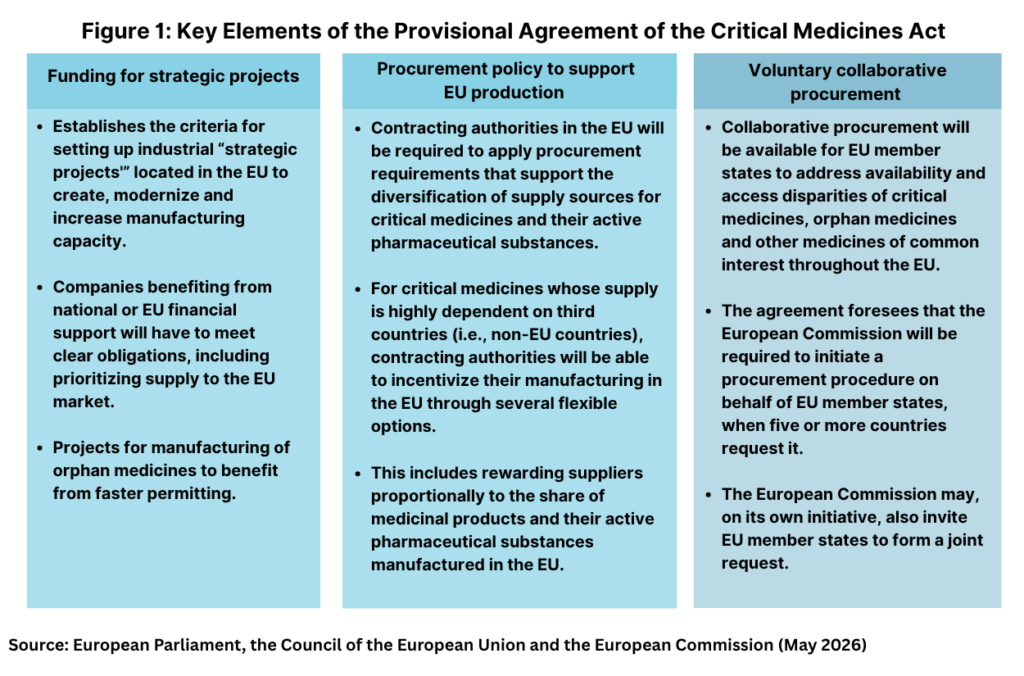
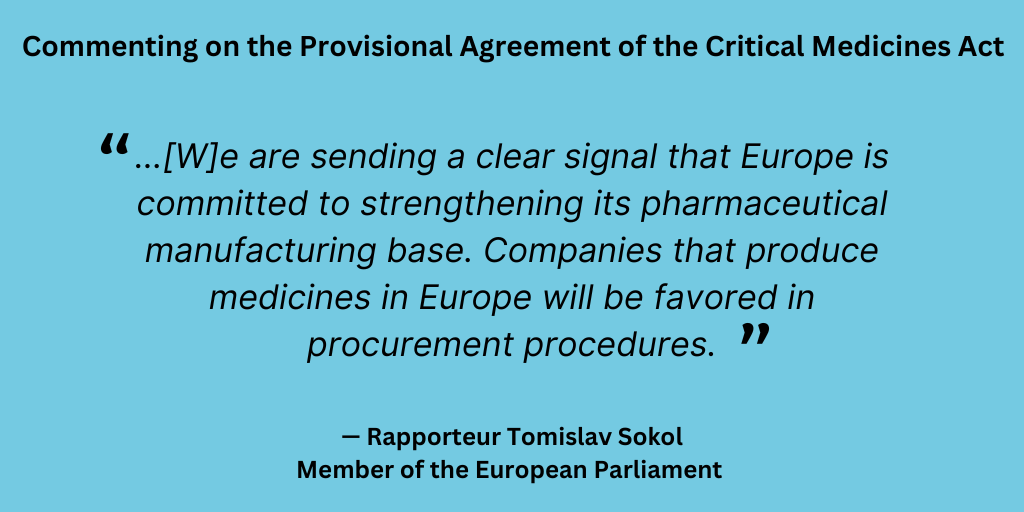
One of the key objectives of the Critical Medicines Act is to strengthen the resilience of critical medicine supply chains in the EU. To this end, the provisional agreement introduces an obligation for contracting authorities to apply resilience-related requirements in public procurement procedures for critical medicines. The new rules also seek to incentivize EU-based manufacturing of critical medicines and their active ingredients to reduce the EU’s dependency on non-EU countries. Contracting authorities in the EU will be required to apply procurement requirements that support the diversification of supply sources for critical medicines and their active pharmaceutical substances. For critical medicines, whose supply is highly dependent on third countries (i.e., non-EU countries), contracting authorities will be able to incentivize their manufacturing in the EU through several flexible options. These include rewarding suppliers proportionally to the share of medicinal products and their active pharmaceutical substances manufactured in the EU. In addition, the the agreement establishes the criteria for setting up industrial “strategic projects” located in the EU to create, modernize and increase manufacturing capacity. Companies benefiting from national or EU financial support will have to meet clear obligations, including prioritizing supply to the EU market.
With respect to collaborative procurement, referring to joint procurement by EU member states in pooling resources to acquire critical medicines, measures will allow EU countries to join forces when procuring critical medicines and medicines of common interest, thereby strengthening their collective leverage. The measures also reduced the threshold number of EU member states required to submit a request to the European Commission to procure on their behalf from nine countries to five.
With respect to contingency-stock requirements, when EU member states require companies to hold contingency stocks, they will have to ensure that this does not negatively affect supply of critical medicines in other EU countries. The provisional agreement includes new measures allowing EU member states to share relevant information about contingency stock requirements. The agreement clarifies the use of the existing voluntary solidarity mechanism in ensuring that data on contingency stocks is exchanged between EU member states and provides the means for countries to reallocate critical medicine products, if needed, on a voluntary basis.
With respect to orphan medicines, the scope of the act was expanded to include orphan medicinal products in certain key areas, including strategic projects and collaborative procurement. In the EU, orphan medicinal products are defined as conditions that affect no more than 5 in 10,000 people in the EU.
Medicines for Europe, which represents generic-drug and biosimilar producers in Europe, provided support for the agreement but is also calling for other measures, including more funding on an EU-level to support manufacturing in the EU and to address other policy issues, such as the Urban Waste Water Treatment Directive, which contribute to the cost of production in the EU.
“The Act is the first European step to strengthen critical medicines supplies and reduce shortages,” said Medicines for Europe Director General Adrian van den Hoven, in a May 15, 2026, statement. “The next EU budget should include a competitiveness €4 billion fund to support generic medicine and API production. This would support upgrades for security of supply or resilience for over 150 production sites in Europe and would be important for national security interests.”