


The State of the State: Continuous Manufacturing

FDA’s Emerging Technology Program, a collaborative program between the agency and industry, aims to facilitate bio/pharma companies’ adoption of new manufacturing technologies, including continuous manufacturing. Where do things stand?
By Patricia Van Arnum, Editorial Director, DCAT, [email protected]
Continuous manufacturing: where does it stand?
Although a batch manufacturing industry, the bio/pharmaceutical industry continues to evaluate and to a certain degree, implement, projects using continuous manufacturing. But where does the industry stand in its adoption?
For one perspective, Adam Fisher, Director, Enterprise Project Staff, in the Office of Pharmaceutical Quality in the Center for Drug Evaluation and Research (CDER) at the US Food and Drug Administration (FDA), provided an update on the use of continuous manufacturing as used in the agency’s Emerging Technology Program. He spoke at the Regulatory Education for Industry (REdI) Annual Conference 2026: Innovative Regulatory Strategies to Advance Medical Products, which was held last month (May 2026). The RedI conference is an annual conference hosted by FDA to educate small businesses, researchers, and innovators on how FDA regulates drugs, medical devices, and biologics and to create awareness of the agency’s current activities.

For continuous manufacturing and other new technologies, adopting innovative approaches to manufacturing may present both technical and regulatory challenges. On the regulatory front, pharmaceutical companies may have concerns that developing such technologies could result in delays while novel regulatory challenges are considered. This is especially true while regulatory assessors familiarize themselves with new technologies and determine how they may be evaluated within the existing regulatory framework. To address these concerns, the Office of Pharmaceutical Quality under FDA’s CDER created the Emerging Technology Program in 2014 as a collaborative program where industry representatives can meet with Emerging Technology Team members to discuss, identify, and resolve potential technical and regulatory issues regarding the development and implementation of a novel technology prior to filing a regulatory submission.
To qualify for participation in FDA’s Emerging Technology Program, technologies need to have the potential to improve product safety, identity, strength, quality, and purity and include one or more of the following elements subject to quality assessment for which FDA has limited review or inspection experience, including an innovative or novel approach. These elements are product technology (e.g., dosage form or packaging such as a container and closure system); manufacturing process (e.g., design, scale-up or lifecycle approaches); or control strategy (e.g., testing technology or process controls).
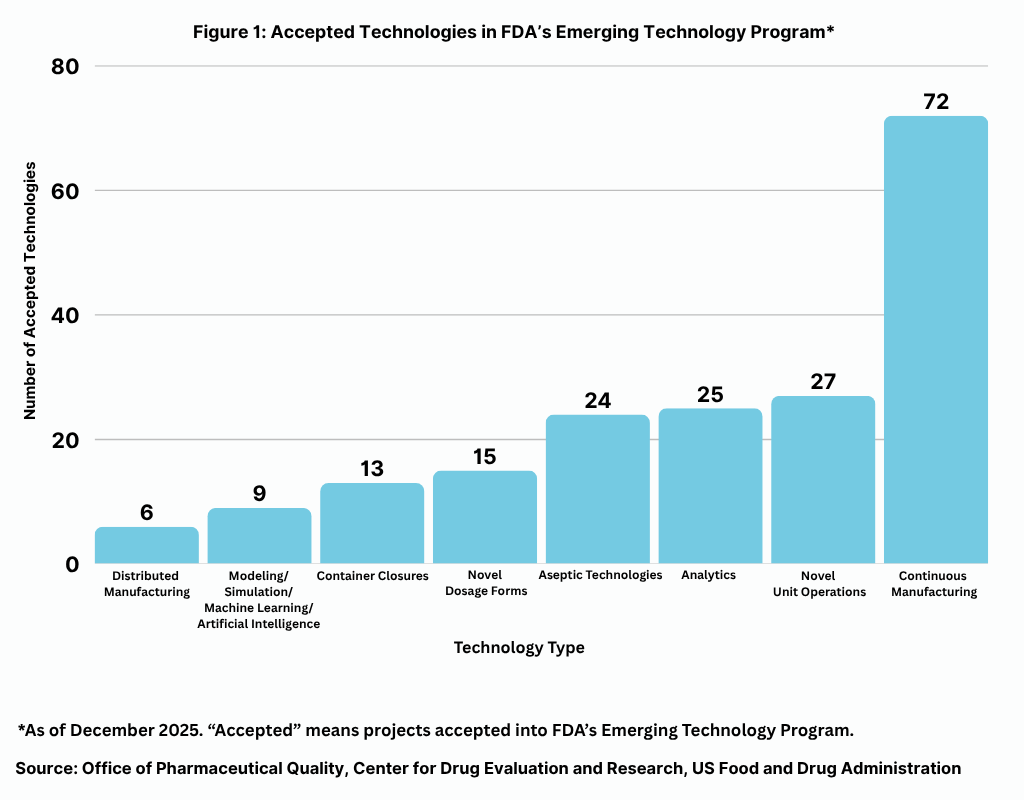
In looking at the type of technologies accepted for participation in FDA’s Emerging Technology Program, continuous manufacturing was by far the technology with the greatest number of projects accepted into the program with 72 (see Figure 1). The second most common technology related to novel unit operations, which received 27 acceptances. Other technologies accepted in FDA’s Emerging Technology program were analytical technologies (25 acceptances), aseptic technologies (24), novel dosage forms (15), container closures (13), modeling/simulation/machine learning/artificial intelligence (9 acceptances), and distributed or point-of-care manufacturing models (6 acceptances). These numbers are acceptances from the inception of the program to December 2025.
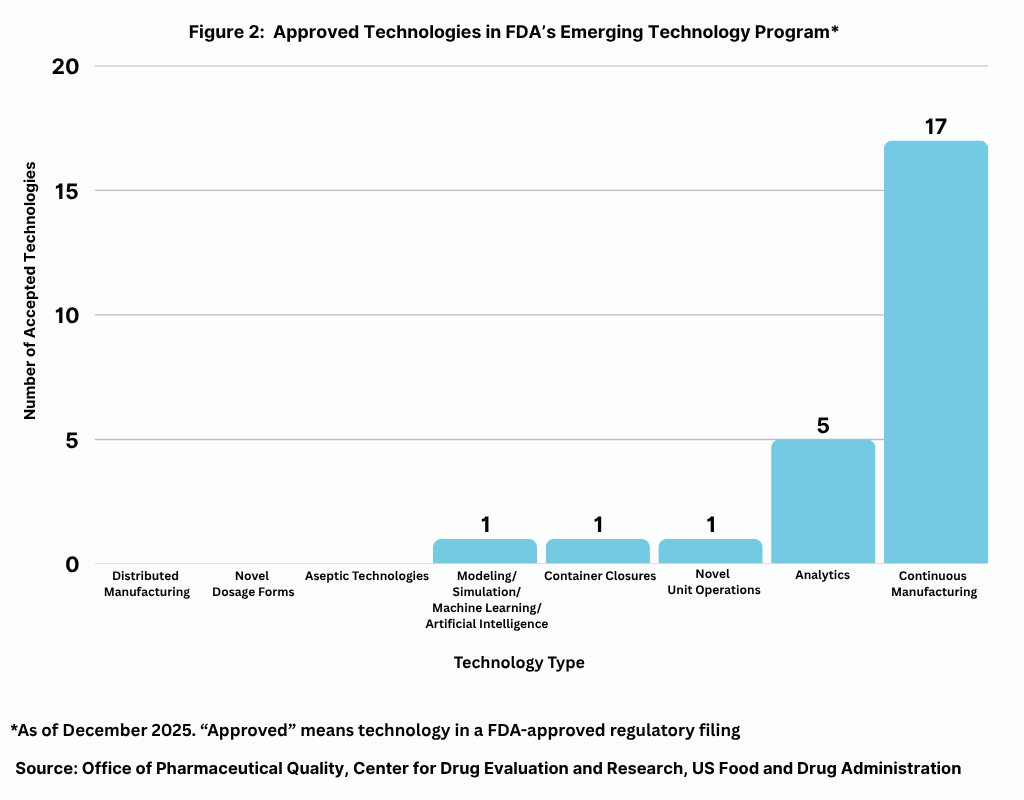
Acceptance into FDA’s Emerging Technology Program is a broad measure of interest in a particular technology. Of greater interest is whether the given technology was part of an approved regulatory submission to FDA. Since the inception of the FDA’s Emerging Technology Program, continuous manufacturing led all technologies with 17 regulatory submissions using continuous manufacturing approved by FDA (see Figure 2).
Technologies in the Emerging Technology Program remain part of the program until they “graduate” from the program. Graduation is the process through which the Emerging Technology Program transfers review responsibility of future application submissions from the program to the standard quality assessment process and regulatory review. Continuous direct compression (CDC), a unit operation in solid dosage manufacturing, was the first technology to graduate from the program in 2021. CDC was first accepted to the program in 2015 and since then, the program has engaged with CDC sponsors across multiple applications to provide scientific input on the technology’s development. To facilitate graduation, members of the Emerging Technology Team apply their knowledge and experience working with CDC to train and provide guidance to FDA reviewers on the technology.
End-to-end continuous manufacturing: FRAME
Following a 2021 report by the National Academies of Sciences, Engineering, and Medicine that identified innovations CDER is likely to encounter that have the potential to advance pharmaceutical manufacturing and with further engagement with stakeholders through the Emerging Technology Program, CDER established a separate initiative, the Framework for Regulatory Advanced Manufacturing Evaluation (FRAME), to prepare a regulatory framework to support the adoption of advanced manufacturing technologies. The FRAME initiative prioritized four technologies, one of which involves continuous manufacturing that would entail continuous manufacturing not just of the drug substance or drug product but end-to-end continuous manufacturing from raw materials to the finished drug product. The four technologies of interest under FRAME are outlined below.
End-to-End Continuous Manufacturing. A fully integrated process into which raw materials are continuously fed and transformed and finished drug products are continuously removed.
Distributed Manufacturing. A decentralized manufacturing strategy that has manufacturing units that can be deployed to multiple locations.
Distributed Manufacturing Units at Non-Traditional Host Sites: This would include, for example, distributed manufacturing units at healthcare facilities.
Artificial Intelligence (AI): Using software and hardware systems that can perceive the environment, interpret data, and decide actions.